First DAAD Award Recipient at HSU/UniBw H: Captain Pierre K. Honored for Outstanding Achievements

HSU

20. October 2026

Hamburg. As part of the 2026 enrollment ceremony, the DAAD Prize for Outstanding International Students was awarded for the first time at Helmut Schmidt University/University of the Federal Armed Forces in Hamburg. The award went to Captain Pierre K., who has been studying Digital Engineering at Helmut Schmidt University/University of the Federal Armed Forces (HSU/UniBw H) since October 2024. The award recognizes his outstanding academic achievements as well as his commitment to his fellow students and his dedication to educational and social projects.

Pierre K. is a captain in the Togolese Armed Forces and came to Germany in April 2023 as part of the Military Training Assistance program. Before beginning his studies at HSU/UniBw H, he first completed language training at the Federal Language Office in Hürth and then attended the preparatory college at the Bundeswehr Technical School in Berlin. He has been studying Digital Engineering at HSU/UniBw H since the fall semester of 2024. His instructors took notice of his achievements early on. During his studies, he has not only impressed with an outstanding grade point average but has also actively contributed to research projects at his department as part of a specialized internship.

“Being the first student at HSU/UniBw H to receive this DAAD award means a great deal to me. I see this award as a great honor and am very pleased to have received it. At the same time, I am proud to be able to represent my home country, Togo, through this award.”
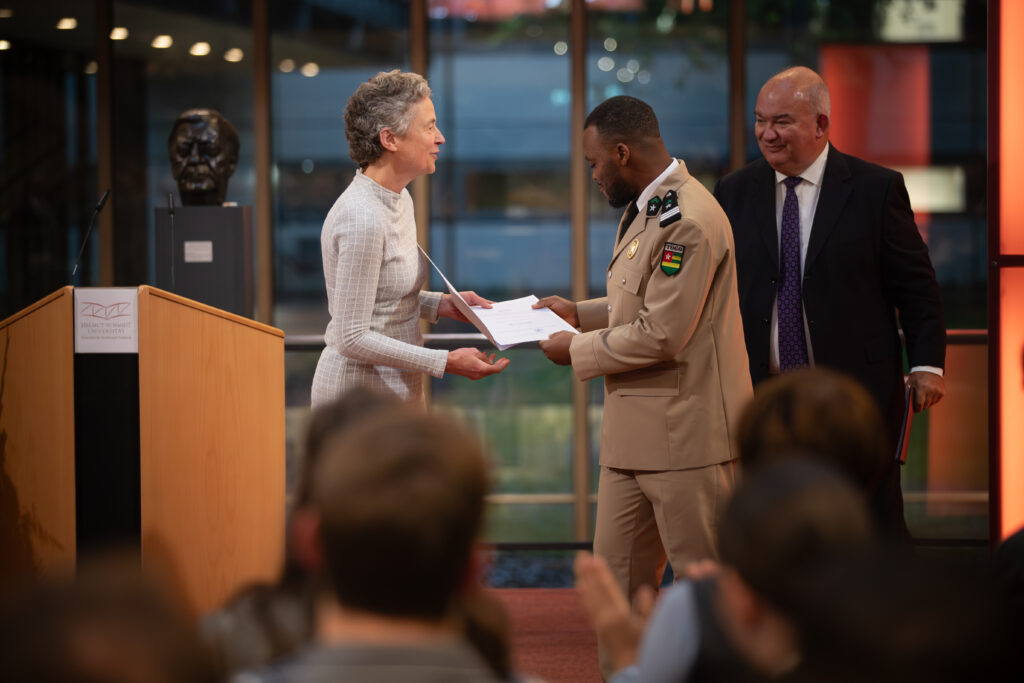
A person in uniform accepts a certificate from another person in front of an audience. A third person is standing nearby.
At the awards ceremony: Captain Pierre K. accepts the certificate for the 2026 DAAD Prize.

For him, success also means supporting others

The DAAD Prize honors international students who combine academic achievement with social engagement. It is precisely this combination that Prof. Dr. Stefan Dickmann, professor of fundamentals of electrical engineering and dean of academic affairs—who nominated Hauptmann for the DAAD Prize—also highlights.

What may sound obvious to many is, for Captain Pierre K., an expression of a deep personal conviction. His actions are strongly shaped by his Christian faith. He does not take much of what he has achieved for granted and sees in this a responsibility to support others as well:

“I’ve received a lot of support myself. That’s why it’s important to me to give back and support others on their journey. If I can help open up new opportunities for people, I’m happy to do so.”

A fascination with the logic behind technology

His enthusiasm for his field of study is obvious. He is particularly fascinated by the connection between mathematics, physics, and engineering.

“I’m fascinated by the logic behind the physical phenomena in electrical engineering. Solving problems step by step and understanding how things are connected is what makes this field so appealing to me.”

It’s not just about formulas or technical systems. Captain Pierre K. particularly values courses in which complex concepts are explained in an understandable way. When something that initially seems puzzling gives way to genuine understanding, he considers that one of the most rewarding moments of learning.

Involvement far beyond the campus

However, his commitment to helping others does not end at the boundaries of Helmut Schmidt University/University of the German Armed Forces in Hamburg. Through his church congregation, he is involved in educational projects in Africa and supports initiatives that provide children with access to education.

In addition, he and his partner are actively involved in social projects in Burkina Faso and Lomé. Their efforts focus on supporting women and girls. This commitment stems from the observation that many young women are forced to drop out of school due to early pregnancies, thereby losing important opportunities for their future.

To open up new opportunities for these women, his partner founded the organization Femmes d’impact. Captain Pierre K. supports the initiative’s work both financially and as a volunteer.

“Education opens up opportunities and changes the course of people’s lives. That’s why it’s important to me to help where people wouldn’t otherwise have these opportunities.”

Development as a Conscious Choice

When asked what he is most proud of in his life so far, Pierre K. mentions neither his grades nor the DAAD Award.

What was much more important to him was a decision that had shaped his entire life:

“To me, personal growth means making a conscious decision to learn something new every day and to become a better person. That’s the decision I’m most proud of to this day.”

He also shares this insight with other international students. Linguistic and cultural challenges are part and parcel of studying abroad. At the same time, Germany offers many opportunities for those who are willing to take advantage of them.

In his view, openness, interaction, and mutual support are just as important as academic achievement. Or, as he puts it himself: “If you can build bridges with other people while you’re studying, that’s always a good thing.”

With his outstanding academic achievements, his dedication to his fellow students, and his longstanding commitment to the community, First Lieutenant Pierre K. embodies in a special way the spirit of the DAAD Award: combining academic excellence with a sense of responsibility toward others.
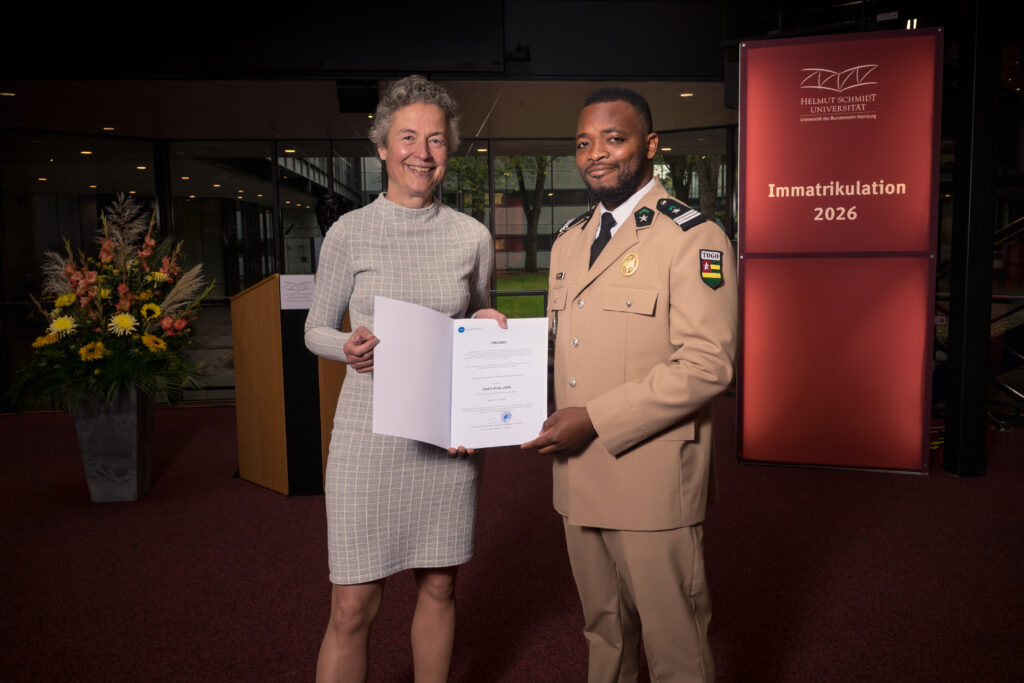
At the 2026 enrollment ceremony, two people are standing side by side, holding the certificate for the 2026 DAAD Prize up to the camera. In the background, a red HSU/UniBw H stele bearing the inscription “Enrollment 2026” is visible.
DAAD Award recipient Hauptmann Pierre K. with Prof. Dr. Christina Schaefer, Vice President for International Affairs, at the award ceremony during the 2026 matriculation ceremony.

International Exchange at HSU/UniBw H

International exchange and study programs are an important part of international cooperation at HSU/UniBw H. They expose students to different academic perspectives and promote exchange across national borders.

The university is therefore all the more pleased to now be able to honor outstanding international students with the DAAD Prize for their academic achievements and social engagement. The fact that the award was presented at HSU/UniBw H for the first time this year is largely due to the dedication of the International Office under the leadership of Linda Weiß.

Helmut Schmidt University/University of the Federal Armed Forces in Hamburg extends its heartfelt congratulations on this award.

IPC Field Trip in Brussels: Insights into European Procurement and Defense

HSU

22. July 2026

Brussels. The first IPC Field Trip, held from May 4 to 6, 2026, as part of the continuing education master’s program in International Procurement Cooperation (IPC) at HSU/UniBw H, took students to Brussels. While there, they met with international experts from the fields of research, the military, politics, and industry and gained insights into current challenges facing European security and defense policy as well as international procurement.

University President Prof. Klaus Beckmann Delivers a Speech at the IPC Field Trip in Brussels
University President Prof. Dr. Klaus Beckmann will open the First IPC Field Trip to Brussels with a welcoming address at the Hanse-Office, the joint representation of the Free and Hanseatic City of Hamburg and the State of Schleswig-Holstein to the European Union.

Day 1: Strategic Perspectives on European Defense

The first day focused on the strategic framework of European security and defense policy and began with welcoming remarks from political, administrative, and military leaders—including University President Prof. Dr. Klaus Beckmann—at the Hanse-Office, the representative office of Hamburg and Schleswig-Holstein to the European Union.

The focus was on key instruments such as European defense industry policy, the European Global Strategy, and the Strategic Compass. It became clear that translating political objectives into concrete measures poses a challenge.

Presentations by the European Commission, the European Parliament, and the European Defense Agency (EDA) provided context for current developments and, at the same time, highlighted a growing willingness to cooperate within Europe.

The day concluded with an informal gathering at the Royal Military Museum/War Heritage Institute, during which Prof. Dr. Christina Schaefer, Vice President for International Affairs at HSU/UniBw H, delivered a welcoming address.

: View of Brussels from the rooftop terrace of the Royal Military Museum/War Heritage Institute.
Prof. Dr. Schaefer, Vice President for International Affairs at HSU/UniBw H, delivers a welcoming address to kick off the evening event at the Royal Military Museum/War Heritage Institute.

Day 2: Implementation and European Cooperation

On the second day, the focus was on the practical implementation of European defense initiatives. Representatives from international organizations such as the NATO Support and Procurement Agency (NSPA), the Organization for Joint Armament Cooperation (OCCAR), and the European Defense Agency (EDA) provided insights into programs and cooperation models.

The focus was on:

  • joint procurement processes
  • the role of the stakeholders involved
  • Funding and Innovation Issues

The discussion focused on how cooperation among member states is organized in practice and what contribution the EU makes to building strategic capabilities.

: Brigadier General Nathalie Guichard, Director of Research, Technology, and Innovation at the European Defense Agency (EDA).
From left to right: Mr. Joachim Sucker, Director of OCCAR-EA (Organization for Joint Armament Cooperation), Lt. Col. Volker Bäcker (current IPC student and moderator of the IPC Field Trip), and Mr. Andrea Millerani, Program Manager of the Modular and Multirole Patrol Program (MMPC).

Day 3: Operational Insights and Best Practices

The third day focused on operational perspectives and national viewpoints. Representatives from the countries where the current IPC students come from (Germany, Austria, the Netherlands, Sweden, Belgium, and Bulgaria) contextualized current developments within their respective contexts.

A concluding panel discussion on the topic “International Procurement Cooperation – Best Practices” brought together experiences from various sectors, including air, land, sea, space, and cyber. The discussion focused on the factors that contribute to the success of international procurement projects.

Lieutenant General Wolfgang Wien, Germany's military representative to the EU and NATO.
Lively panel discussion (from left to right): Mark Mozer (BAAINBw), João Abreu (DG DEFIS), Lara Polster (moderator, Motorenfabrik Hatz GmbH), Brigadier General Dr. Mag. (FH) Matthias Sebera (Austrian Ministry of Defense), Colonel Bernard Kestelyn (La Défense), Inge Weyers (Dutch Ministry of Defense), and Captain Tom (IPC student).

Exchange and Classification

The IPC Field Trip highlighted the importance of international and interdisciplinary cooperation for the further development of security and procurement structures in Europe. In addition to technical insights, the event focused on personal exchanges.

The participants expanded their knowledge, gained practical insights, and made international connections.

Interested in the IPC master’s program?

The International Procurement Cooperation (IPC) Master’s program is designed for professionals and executives in the fields of procurement and security. If you’re interested, we invite you to apply for the third IPC cohort, which will begin its studies on November 1, 2026!

Application deadline: June 30, 2026

First Welcome Reception for International Employees

HSU

11. December 2025

On December 4, 2025, the newly established Welcome Office at HSU/UniBw Hamburg hosted its inaugural welcome reception.

All international scientists who were hired directly from abroad in 2025 accepted the president’s invitation to the festively decorated Officers’ Club last Thursday; many attended with companions.

In his welcoming speech, President Prof. Beckmann emphasized the importance of international staff members for the further development of internationalization and praised their contribution to increasing the university’s international visibility.

At the subsequent “cheese and wine” reception, guests and hosts quickly struck up conversations.

The first Welcome Reception culminated with a joint visit to the traditional Christmas market of the Student Department Alpha.

This Reception is intended to be the start of a series of events that the Welcome Office plans to offer to all international employees of HSU/UniBw Hamburg in the coming months. As part of HSU/UniBW Hamburg’s welcome culture, connecting international staff members is one of the central goals of the Welcome Office, alongside supporting international visiting researchers.

International research collaboration in the field of “AI in higher education, training and adult education”

HSU

3. May 2024

International research collaboration of the Professorship for Continuing Education and Lifelong Learning at Helmut Schmidt University/University of the Federal Armed Forces Hamburg in the field of “AI in higher education, training and adult education”.

The International survey on artificial intelligence in higher education, training and adult learning led by the IAL (Institute for Adult Learning, Singapore) examines how technological innovations are changing our educational world globally. The aim is to analyze the integration of (generative) artificial intelligence (AI) as a pioneer for learning landscapes and future trends in higher education, training and adult education worldwide.

The global research project with currently over 23 countries, was initiated by the Research Network 3 of the ASEM Education and Research Hub for Lifelong Learning. Prof. Schmidt-Lauff (member of the ASEM network since 2022), together with the German Institute for Adult Education (DIE, Bonn), is responsible for Germany-wide data collection, data evaluation and dissemination of the results.

Cooperation with MIT Center of Bits and Atoms launched

HSU

3. May 2024

As part of a forward-looking sustainability-project the Helmut-Schmidt-Universität/University of the Armed Forces Hamburg (HSU/UniBw H) is now cooperating with the Massachusetts Institute of Technology (MIT) Center of Bits and Atoms. Prof. Klaus Beckmann, President of the HSU/UniBw H, and Prof. Neil Gershenfeld, Head of the MIT Center for Bits and Atoms, just signed the treaty in Hamburg.

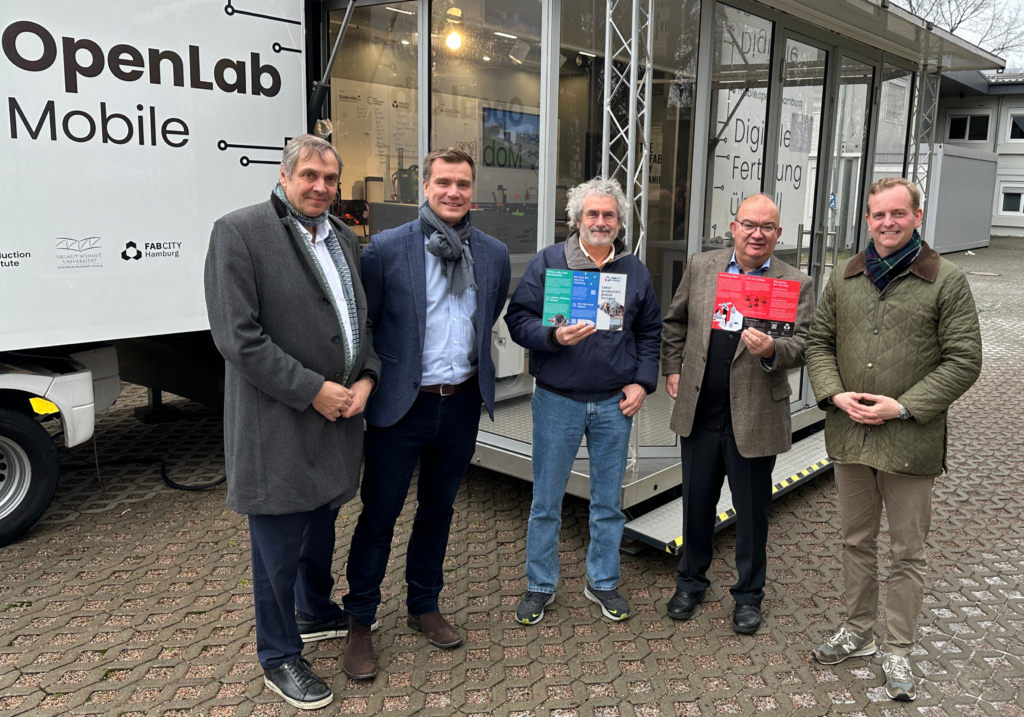
Fünf Wissenschaftler stehen nebeneinander vor dem OpenLab Mobile der Helmut-Schmidt-Universität/Universität der Bundeswehr Hamburg.
Prof. Neil Gershenfeld, MIT (center) with Prof. Klaus Beckmann, President of the Helmut-Schmidt-Universität/University of the Armed Forces Hamburg (HSU/UniBw H, 2nd from the right), Dr. Jürgen Glaser (Süderelbe AG), Dr.–Ing. Tobias Redlich and Dr.–Ing. Manuel Moritz (HSU/UniBw H) in front of the OpenLab Mobile.

Locally produced. Globally connected. The Fab City project aims to establish resilient and sustainable cities by pursuing an integrative approach. This approach includes the sharing of knowledge within a global network and the systematic characterization of infrastructure technologies for local production.  

Focussing local production

One focus is on developing and scaling a broad range of capabilities relevant to local production in key areas such as food, energy and shelter. This is where the new cooperation between the New Production Institute headed by Dr.–Ing. Tobias Redlich at the Laboratory for Production Technology (LaFT) at HSU/Uni Bw H and the Massachusetts Institute of Technology (MIT) Center for Bits and Atoms headed by Prof. Neil Gershenfeld comes in. A multidisciplinary team from HSU and MIT is researching new technologies within various domains.

Quantifying the flow of energy and material

This also includes cataloguing the best methods for Fab City technologies, including the areas of manufacturing machines, measuring instruments, materials, furniture, clothing, consumer electronics, toys, data networks, robots and transport. The development of innovative ideas to quantify material and energy-flows coming in and going out of a city, costs and benefits, productivity and scalability, as well as metrics to identify priorities relevant to the future of Fab Cities is crucial.