Aim and Scope
Symbolic planning, Reinforcement Learning, and emerging directions such as LLMs for planning and Neuro-Symbolic approaches all contribute important theoretical and applied perspectives on sequential decision-making. However, these communities often evolve in parallel, with distinct assumptions, theoretical backbones, methods, benchmarks, and forms of evaluation. As a result, progress on planning is fragmented across community boundaries, despite a shared interest in solving complex decision-making problems.
This joint workshop aims to bring these communities together across both dimensions of the field: theoretical foundations and applications. It provides a platform for researchers working on symbolic, learning-based, and hybrid planning approaches to discuss common challenges, compare methodologies, and identify opportunities for integration. By fostering exchange across established and emerging research directions, the workshop seeks to strengthen connections within the broader planning community and support the development of more general and practically relevant planning approaches.
Topics of Interest
We invite submissions at the intersection of AI Planning and (Reinforcement) Learning for theoretical and applied problems. The topics of interest include, but are not limited to, the following
- Novel real-world applications for planning and reinforcement learning
- Novel planning algorithms for real-world applications
- Usage of Large Language Models (LLMs) in planning and reinforcement learning
- Automated generation of planning domain descriptions
- Reinforcement learning (model-based, Bayesian, deep, hierarchical, etc.)
- Learning for planning (L4P)
- Generalized planning
- Monte Carlo planning
- Model representation
- Model learning
- Planning using approximated/uncertain (learned) models
- Learning search heuristics for planner guidance
- Theoretical aspects of planning and reinforcement learning
- Dataset and Benchmarks across planning and RL
- Action policy analysis or certification
- Reinforcement learning and planning competition(s)
Important Dates
Paper submission deadline: May 15, AOEPaper submission deadline: May 25, CETPaper acceptance notification: June 15, AOESubmission of Camera-Ready Version: August 1, AOEWorkshop takes place on August 17, Bremen, Germany
IJCAI will be in-person this year. Authors of accepted workshop papers are expected to physically attend the conference and present in person.
We will not accept video presentations.
Program
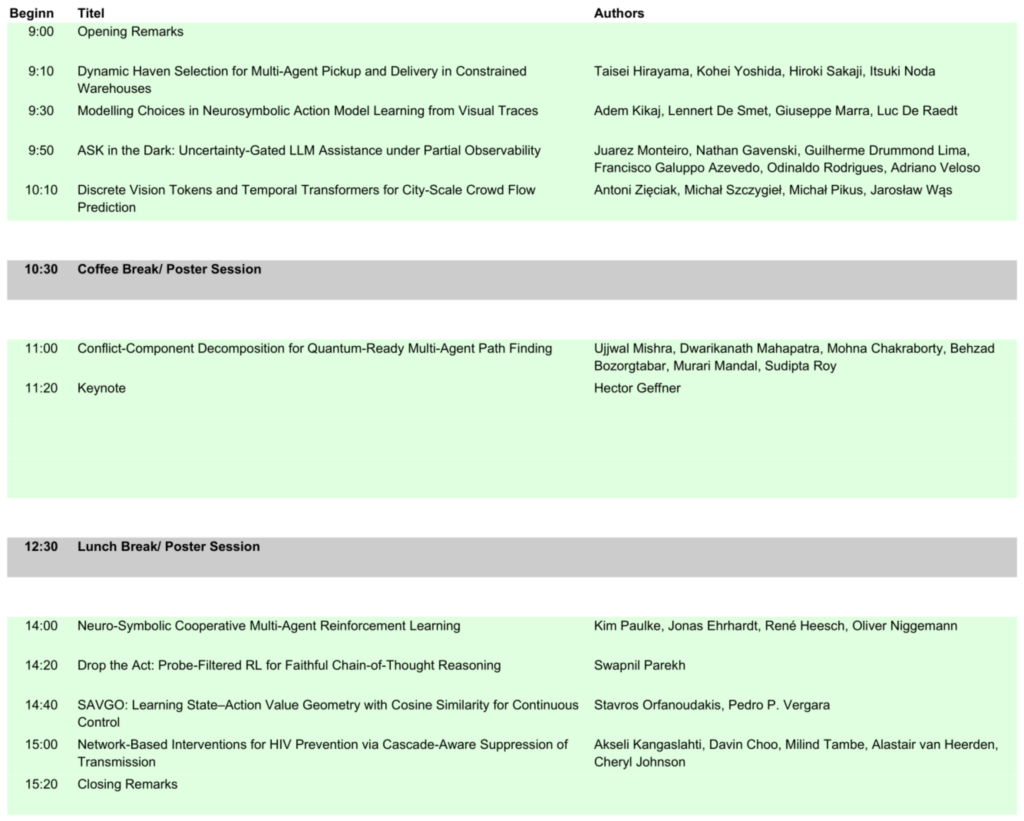
You can download the program as PDF here


Organizing Committee
- Forest Agostinelli, University of South Carolina, Columbia, USA.
- Zlatan Ajanović, RWTH Aachen University, Aachen, Germany.
- Gautam Biswas, Vanderbilt University, Nashville, USA.
- Jonas Ehrhardt, Helmut-Schmidt-University, Hamburg, Germany.
- Alexander Diedrich, Helmut-Schmidt-University, Hamburg, Germany.
- Timo P. Gros, German Research Center for Artificial Intelligence (DFKI), Saarbrücken, Germany.
- René Heesch, Helmut-Schmidt-University, Hamburg, Germany.
- Andrea Micheli, Fondazione Bruno Kessler, Trento, Italy.
- Oliver Niggemann, Helmut-Schmidt-University, Hamburg, Germany.
- Shahaf S. Shperberg, Ben-Gurion University, Be’er Sheva, Israel.
- Ayal Taitler, Ben-Gurion University, Be’er Sheva, Israel.
- Niklas Widulle, Helmut-Schmidt-University, Hamburg, Germany.
Please send your inquiries to [email protected]
Program Committee
Alexandre Albore, French Aerospace Lab
Kaja Balzereit, Faculty of Engineering and Mathematics, University of Applied Sciences Bielefeld
Arthur Bit-Monnot, Laboratory for Analysis and Architecture of Systems, French National Centre for Scientific Research
Alexander Diedrich, Institute of Artificial Intelligence, Helmut Schmidt University
Jonas Ehrhardt, Institute of Artificial Intelligence, Helmut Schmidt University
Aljosha Köcher, Institute of Automation Technology, Helmut Schmidt University
Ingo Pill, Institute for Software Technology, Graz University of Technology
Marcos Quinones-Grueiro, Institute for Software Integrated Systems, Vanderbilt University
Elisa Tosello, Planning Scheduling and Optimization Unit, Fondazione Bruno Kessler
Luis Miguel Vieira da Silva, Institute of Automation Technology, Helmut Schmidt University
Niklas Widulle, Institute of Artificial Intelligence, Helmut Schmidt University
Alexander Windmann, Institute of Artificial Intelligence, Helmut Schmidt University
Alois Zoitl, LIT Cyber-Physical Systems Lab, Johannes Kepler University Linz
Patrick Rodler, University of Klagenfurt
Scott Sanner, University of Toronto
Argamann Mordoch, Ben-Gurion University, Be’er Sheva
Forest Agostinelli, University of South Carolina
Zlatan Ajanović, RWTH Aachen University
Dillon Ze Chen, Laboratory for Analysis and Architecture of Systems (LAAS-CNRS)
Timo P. Gros, German Research Center for Artificial Intelligence (DFKI)
Shahaf S. Shperberg, Ben-Gurion University
Ayal Taitler, Ben-Gurion University, Be’er Sheva
Roni Stern, Ben-Gurion University, Be’er Sheva
Letzte Änderung: 24. August 2026