Contact: Dr. rer. nat. Alexander Diedrich
Modern cyber-physical systems (CPS) are hierarchically organized, modular in structure, and increasingly shaped by learning-based components. Purely data-driven approaches reach structural limits in safety-critical and industrial applications: they neither represent explicit cause-effect relationships nor account for the compositional architecture of real technical systems. Our research programme develops formally grounded system models that integrate into neuro-symbolic architectures for diagnosis, reconfiguration, and adaptive supervision of CPS. A key feature of our approach is that symbolic and data-driven methods are not treated as competing paradigms but designed to complement each other at every level — from system modelling through fault detection to automated intervention.
Research Direction 1: Structural Modelling with SMT-Logic
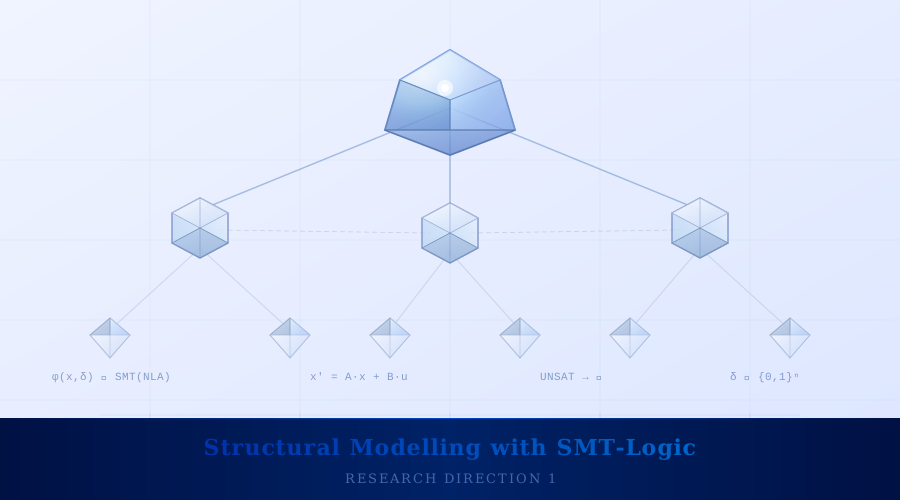
A central challenge in modelling technical systems is the formal representation of hybrid behavior — the combination of continuous physical dynamics with discrete control logic. Our work uses formal logic, in particular Satisfiability Modulo Theory (SMT), as a formalism for encoding system structure, component behavior, and logical constraints within a coherent framework. System components are represented together with the system’s observations.
SMT solvers then operate on these representations to enforce structural consistency, detect contradictions, and derive valid system states. The structural representations developed here form the foundation for the causal models in Research Direction 2 and serve as formal system descriptions for the fault diagnosis and reconfiguration algorithms in Research Direction 3. The theoretical foundation unifying these contributions is a novel CPS modelling formalism drawing from both AI and control theory, representing system structure and behavior through SMT over nonlinear arithmetic while accommodating the hybrid discrete-continuous nature of real CPS and structural changes over a system’s lifetime.
Diedrich, A., Maier, A., & Niggemann, O. (2019). Model-based diagnosis of hybrid systems using satisfiability modulo theory. Proceedings of the AAAI Conference on Artificial Intelligence, 33(01), 1452–1459. https://doi.org/10.1609/aaai.v33i01.33011452
Heesch, R., Ehrhardt, J., & Niggemann, O. (2023). Integrating machine learning into an SMT-based planning approach for production planning in cyber-physical production systems. ECAI 2023 Workshop on Hybrid Models for Coupling Deductive and Inductive Reasoning (HYDRA), Kraków, Polen.
Heesch, R., Cimatti, A., Ehrhardt, J., Diedrich, A., & Niggemann, O. (2024). A lazy approach to neural numerical planning with control parameters. Proceedings of the 27th European Conference on Artificial Intelligence (ECAI 2024), Santiago de Compostela, Spanien.
Diedrich, A., Heesch, R., Bozzano, M., Ludwig, B., Cimatti, A., & Niggemann, O. (2024). Inferring sensor placement using critical pairs and satisfiability modulo theory. 35th International Conference on Principles of Diagnosis and Resilient Systems (DX 2024), Wien, Österreich.
Diedrich, A., Krysander, M., Heesch, R., & Niggemann, O. (2025). Modelling cyber-physical systems for fault diagnosis. IEEE Transactions on Systems, Man, and Cybernetics: Systems. (SJR Q1)
Research Direction 2: Causal Modelling
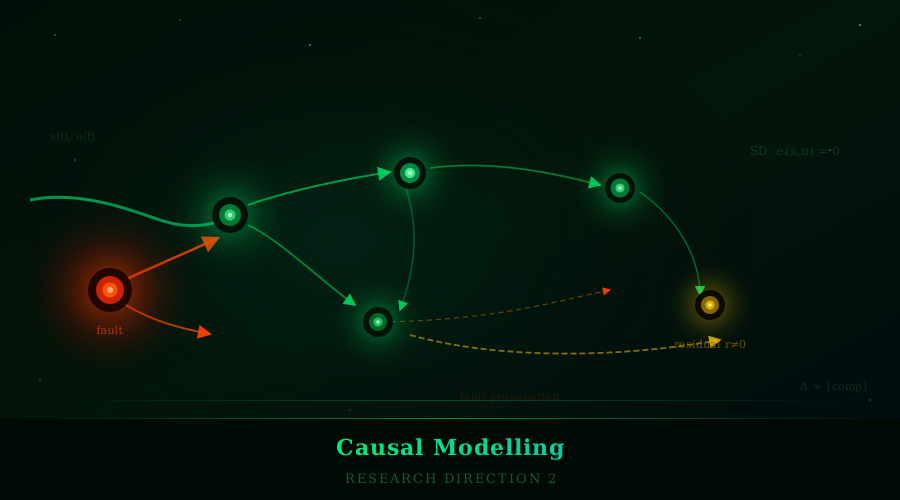
Understanding a technical system requires more than statistical correlation: it requires models that capture how variables influence each other through physical mechanisms. Our research programme develops methods for learning and representing causal structures in CPS, with particular attention to modularity and hierarchical organization. The causal models produced here are grounded in the SMT-based system descriptions of Research Direction 1, and they in turn supply the structured fault signatures and redundancy relations that the diagnosis and reconfiguration methods of Research Direction 3 depend upon.
A central contribution establishes residual-based diagnosis using system descriptions — sets of equations relating sensor measurements to physical quantities — as the basis for deriving analytical redundancy relations that enable causal fault propagation analysis. We have further developed a method for learning system descriptions directly from process data, reducing reliance on expert-crafted models. Moddemann et al. introduced Discret2DeepDive, a deep learning-based discretization approach that transforms continuous CPS time series into the discrete state representations required by model-based diagnosis algorithms — a crucial preprocessing step that bridges the gap between raw sensor data and the symbolic causal models on which Research Direction 3 operates.
Diedrich, A., & Niggemann, O. (2022). On residual-based diagnosis of physical systems. Engineering Applications of Artificial Intelligence, 109, 104636. https://doi.org/10.1016/j.engappai.2021.104636
Merkelbach, S., Diedrich, A., von Enzberg, S., Niggemann, O., & Dumitrescu, R. (2024). Towards the generation of models for fault diagnosis of CPS using VQA models. Machine Learning for Cyber-Physical Systems (ML4CPS 2024), Berlin, Deutschland.
Diedrich, A., Moddemann, L., & Niggemann, O. (2024). Learning system descriptions for cyber-physical systems. 12th IFAC Symposium on Fault Detection, Supervision and Safety for Technical Processes (SAFEPROCESS 2024), Ferrara, Italien.
Moddemann, L., Steude, H. S., Diedrich, A., Pill, I., & Niggemann, O. (2024). Extracting knowledge using machine learning for anomaly detection and root-cause diagnosis. 29th IEEE International Conference on Emerging Technologies and Factory Automation (ETFA 2024), Padova, Italien.
Ludwig, B., Diedrich, A., & Niggemann, O. (2024). Using ontologies to create logical system descriptions for fault diagnosis. 29th IEEE International Conference on Emerging Technologies and Factory Automation (ETFA 2024), Padova, Italien.
Heesch, R; Eilermann, S; Windmann, A; Diedrich, A; Niggemann, O. (2025). Evaluating Large Language Models for Real-World Engineering Tasks, Australasian Joint Conference on Artificial Intelligence
Diedrich, A., Moddemann, L., & Niggemann, O. (2026). On validating propositional logic system descriptions for fault diagnosis. Engineering Applications of Artificial Intelligence, 165, 113379. (SJR Q1)
Research Direction 3: Anomaly Detection, Diagnosis, and Reconfiguration
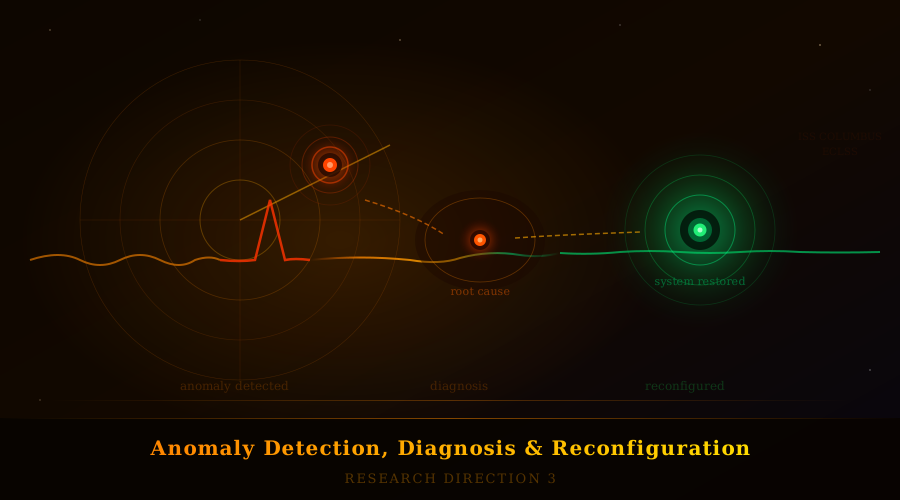
The operational goal of our modelling work is to enable technical systems to detect, diagnose, and respond to faults autonomously — in short: to create intelligent, resilient systems. These three tasks — anomaly detection, diagnosis, and reconfiguration — are tightly coupled in our framework and developed jointly rather than in isolation. The formal system descriptions from Research Direction 1 define what consistency means for a given system, while the causal redundancy relations from Research Direction 2 determine which faults are in principle detectable and isolable. Research Direction 3 closes the loop by turning these representations into running, adaptive fault-handling systems.
Modular neural networks structured to mirror the physical subsystem topology of a CPS were presented at ETFA 2024 as a means of improving anomaly detection quality. Knowledge extraction from data for root-cause diagnosis, enabling anomaly detection and diagnosis with reduced modelling effort, was also presented at ETFA 2024. The CAIPI workshop at ECAI has served as a recurring forum for work at the intersection of planning, causality, and AI for physical systems, with contributions on gradient-based optimization for planning and on learning sound and complete preconditions in complex real-world domains. The role of large language models in supporting diagnostic reasoning was examined by Sztyber-Betley et al., asking whether fundamental diagnostic concepts are within the reach of current LLMs.
Steude, H. S., Moddemann, L., Diedrich, A., Ehrhardt, J., & Niggemann, O. (2023). Diagnosis driven anomaly detection for CPS. 34th International Workshop on Principles of Diagnosis (DX 2023), Loma Mar, USA.
Ehrhardt, J., Overlöper, P., Vranješ, D., Steude, H. S., Diedrich, A., & Niggemann, O. (2024). Using modular neural networks for anomaly detection in cyber-physical systems. 29th IEEE International Conference on Emerging Technologies and Factory Automation (ETFA 2024), Padova, Italien.
Moddemann, L., Steude, H. S., Diedrich, A., Pill, I., & Niggemann, O. (2024). Extracting knowledge using machine learning for anomaly detection and root-cause diagnosis. 29th IEEE International Conference on Emerging Technologies and Factory Automation (ETFA 2024), Padova, Italien.
Ehrhardt, J., Schmidt, J., Heesch, R., & Niggemann, O. (2025). Using gradient-based optimization for planning with deep Q-networks in parametrized action spaces. ECAI 2025 Workshop on AI-based Planning for Complex Real-World Applications (CAIPI’25), Bologna, Italien.
Heesch, R., Ludwig, B., Ehrhardt, J., Diedrich, A., & Niggemann, O. (2025). Learning sound and complete preconditions in complex real-world domains. ECAI 2025 Workshop on AI-based Planning for Complex Real-World Applications (CAIPI’25), Bologna, Italien.
Sztyber-Betley, A., Chanthery, E., Travé-Massuyès, L., Merkelbach, S., Diedrich, A., & Niggemann, O. (2025). Are diagnostic concepts within the reach of LLMs? 36th International Conference on Principles of Diagnosis and Resilient Systems (DX’25), Nashville, TN, USA.
Overlöper, P. J., Diedrich, A., & Niggemann, O. (2026). State-learning of time series data with contrastive learning. In Proceedings of the IEEE Conference on Artificial Intelligence (CAI). IEEE.
Steude, H. S., Diedrich, A., Pill, I., Moddemann, L., Vranješ, D., & Niggemann, O. (2026). Data-driven diagnosis for large cyber-physical systems with minimal prior information. In Proceedings of the IEEE Conference on Artificial Intelligence (CAI). IEEE.
Research Direction 4: Quantum Computing for Diagnosis
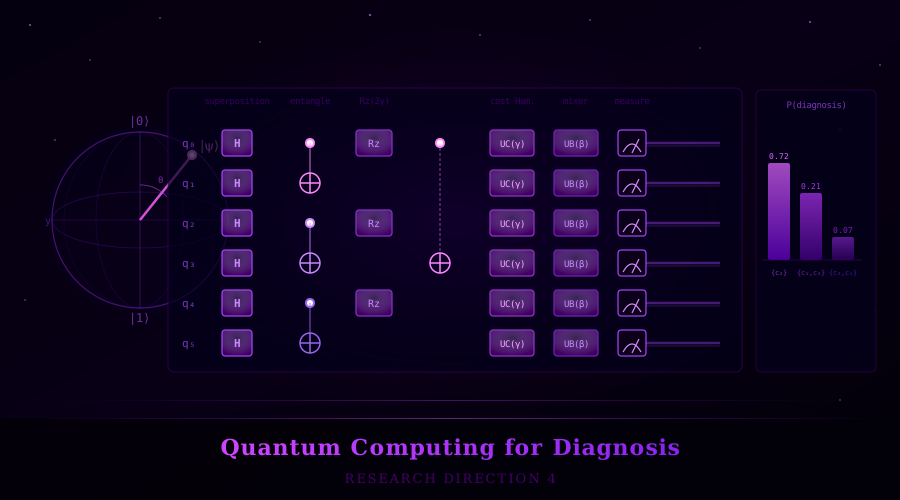
Generating all diagnoses for a complex system is an NP-complete problem, which means classical approaches must rely on incomplete search heuristics. Quantum computers offer a fundamentally different computational model that may overcome these limitations. This research direction complements the symbolic diagnosis framework of Research Direction 3 by addressing its fundamental computational bottleneck: while Research Direction 3 determines in principle what the correct diagnoses are, this direction investigates how they can be found completely and efficiently at scale.
Early theoretical groundwork on the readiness of quantum optimization hardware for industrial applications was developed in collaboration with researchers from NASA, Google, and D-Wave. Building on this, Diedrich et al. applied quantum algorithms directly to model-based CPS diagnosis, proposing approaches based on Grover’s algorithm and the Quantum Approximate Optimization Algorithm (QAOA), evaluated on an IBM Falcon quantum processor using established process industry benchmarks. While current quantum hardware constraints limit scalability, this line of research positions quantum computing as a long-term path toward complete diagnosis in complex systems.
Perdomo-Ortiz, A., Feldman, A., Ozaeta, A., Isakov, S. V., Zhu, Z., O’Gorman, B., et al. (2017). On the readiness of quantum optimization machines for industrial applications. Physical Review Applied. https://doi.org/10.1103/PhysRevApplied.8.014004
Diedrich, A., Windmann, S., & Niggemann, O. (2024). Solving industrial fault diagnosis problems with quantum computers. Quantum Machine Intelligence, 6, 66. https://doi.org/10.1007/s42484-024-00184-x (SJR Q1)
Auswahl an aktuellen Projekten
(K)ISS – Künstliche Intelligenz für die Diagnose der Internationalen Raumstation ISS
This project develops AI-based solutions to support ground station operators in monitoring and diagnosing the International Space Station (ISS). With over 20,000 sensors generating complex data streams, the project combines machine learning methods with symbolic AI to automatically detect anomalies, identify root causes of failures, and assist operators in real-time decision-making. It is funded through dtec.bw and involves both Helmut Schmidt University Hamburg and the Bundeswehr University Munich, with industry partners including Airbus Defence & Space. The project won the Airbus internal DevOps Innovation Award.
ProMoDi – Produktionsnahe Modellwerkstatt zur Forschung an Digitalisierungsthemen im Bereich der Flugzeuginstandhaltung
ProMoDi (Production-Oriented Model Workshop for Research on Digitalization Topics in Aircraft Maintenance) is based at the Institute for Automation Technology at Helmut Schmidt University. It investigates digitalization challenges specific to aircraft maintenance, using a model workshop environment that closely mirrors real production conditions to develop and test new digital methods and processes.
KIPRO – KI-basierte Assistenzsystemplattform für Produktionsprozesse
KIPRO develops an AI-powered assistance system platform for manufacturing environments, with a focus on woodworking machinery — a field traditionally characterized by high levels of manual work and growing product variety. The platform uses machine learning to provide personalized operator support, automatically adapt machine configurations, and detect errors early. It also enables flexible workforce deployment by matching employees to tasks according to their skill levels, aiming to improve both productivity and employee competency development. The project is funded by dtec.bw and hosted at Helmut Schmidt University.
DFG: Using Large Language Models to Generate Modular Anomaly Detection Solutions in Automation
The project develops methods to make data-driven anomaly detection in industrial automation more robust and accurate by leveraging prior knowledge about the system. To this end, Large Language Models are used to extract a modular structural and dynamical description of the plant from plant documentation. This prior knowledge is then integrated into a physics-informed AI model for anomaly detection. The approaches are evaluated on automated production plants of varying complexity.
BMFTR: BioMLAgrar-2 – Biodiversity, Machine Learning and Agriculture
BioMLAgrar-2 investigates how data-driven analysis and forecasting models can be used to support biodiversity management in agriculture. A particular focus lies on ML methods that enable meaningful models even when data availability is limited and that incorporate domain expertise into the modelling process.
Published Benchmarks
Moddemann, L., Ehrhardt, J., Diedrich, A., & Niggemann, O. (2025, September). The HAI-CPPS Benchmark: Evaluating AI Capabilities across Hybrid Data Spaces. In 2025 IEEE 30th International Conference on Emerging Technologies and Factory Automation (ETFA) (pp. 1-8). IEEE.
Ehrhardt, J., Ramonat, M., Heesch, R., Balzereit, K., Diedrich, A., & Niggemann, O. (2022, September). An AI benchmark for diagnosis, reconfiguration & planning. In 2022 IEEE 27th International Conference on Emerging Technologies and Factory Automation (ETFA) (pp. 1-8). IEEE.
Balzereit, K., Diedrich, A., Ginster, J., Windmann, S., & Niggemann, O. (2021, July). An ensemble of benchmarks for the evaluation of AI methods for fault handling in CPPS. In 2021 IEEE 19th International Conference on Industrial Informatics (INDIN) (pp. 1-6). IEEE.
Letzte Änderung: 18. March 2026