Neuerscheinung: Bd.12 (2nd. Edition) Case Study Research

HSU

20. Dezember 2019

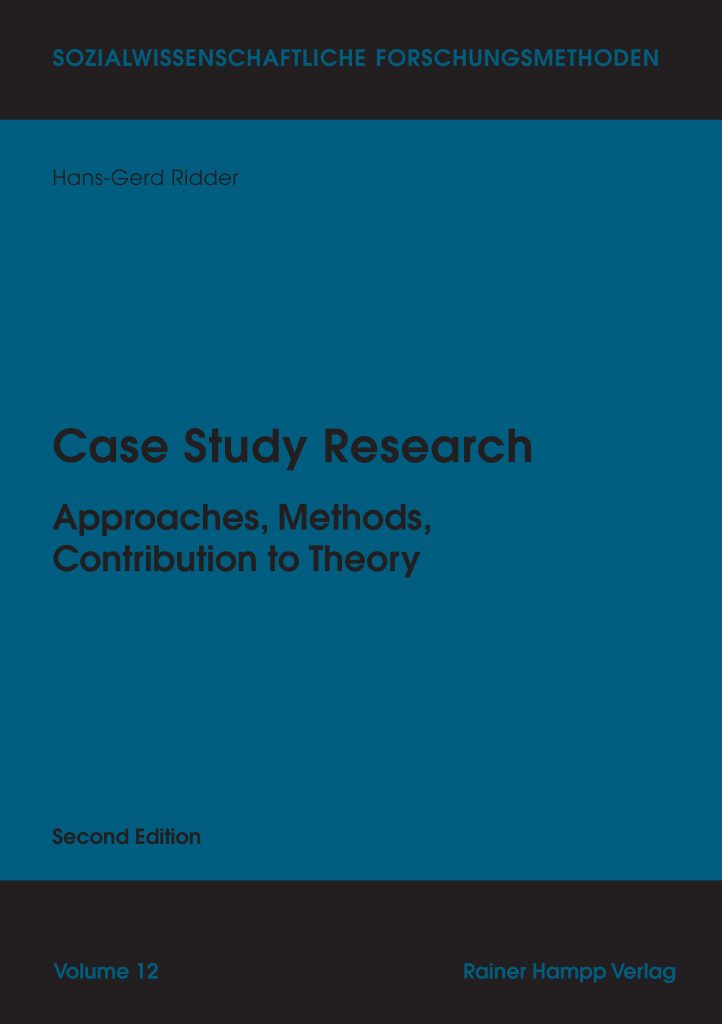
Ridder: Case Study Research (2nd Edition)

Hans-Gerd Ridder

Case Study Research
Approaches, Methods, Contribution to Theory

This book outlines the richness of case study approaches in their contribution to theory. It offers master and doctoral students a systematic overview of how to conduct case study research considering the variety of its approaches. A continuum of theory is outlined in order to clarify the contribution of research designs to theory. Research topics, research questions, and the role of the theoretical and empirical state of the art are discussed. The conceptual framework is displayed as an orientation, guiding the study theoretically as well as methodologically.

The core of the book is the investigation into the main approaches of case study research. Exploratory, explanatory, constructivist, and extended case study approaches are outlined and compared. Commonalities and differences in data collection and data analysis within case study research are deepened.

Key words: Qualitative research, case study research, theory continuum, exploratory case study, explanatory case study, constructivist case study, extended case study

Hans-Gerd Ridder holds the Chair in Human Resource Management at the Leibniz Universität
Hannover. His research focuses on Strategic Human Resource Management in Profit and Non
Profit Organizations.

Online bestellen

Autorenkonferenz „Ökonomie und Ideologie“

HSU

28. Oktober 2019

Am 15. und 16. November 2019 findet an der Helmut-Schmidt-Universität die Autorenkonferenz des von Wenzel Matiaske (HSU) und Werner Nienhüser (Uni Duisburg-Essen) herausgegebenen Jahrbuch Ökonomie und Gesellschaft 31 (Metropolis Verlag) zum Thema „Ökonomie und Ideologie“ im Thomas-Ellwein-Saal statt.

Programm

Worum es geht
Wenn es empirisch zutrifft, dass sich die Wirtschaftswissenschaften mit Knappheit befassen, dann ist Streit über Theorien und Methoden, Wertungen und Gestaltungsmaßnahmen naheliegend oder gar unvermeidlich. Immer wieder taucht in den Auseinandersetzungen der Begriff der Ideologie auf. Nicht selten wird er als polemischer Kampfbegriff verwendet, der all diejenigen Aussagensysteme als ideologisch diskreditiert, die nicht den eigenen Vorstellungen entsprechen.

Die Leitfragen des geplanten Bandes lauten:

  • Produzieren die Wirtschaftswissenschaften Ideologie?
  • Wie geschieht dies? Und was kann man dagegen tun?
  • Kann Wirtschaftswissenschaft auch als Gegenmittel gegen Ideologien eingesetzt werden, welche Merkmale müssten solche wissenschaftlichen Perspektiven und Analysen aufweisen?

Alle Interessierten sind herzlich eingeladen.

MREV Call for Papers: Good Work: Eroding and New Standards in a Changing World

HSU

16. September 2019

management revue – Socio-Economic Studies

Guest Editors :
Sven Hauff, Helmut Schmidt University Hamburg
Daniela Rastetter, University of Hamburg

Special Issue
The changing context of work – e.g. though globalisation, intensification of competition, deregulation, growth in employment flexibility, technological changes, digitalization – increasingly triggers debates about the quality of working life and concerns about the well-being of employees. Observations of precarious forms of employment or increasing demands and intensification of work thereby often elicit nostalgic memories of the apparently ‘good old days’ where work was characterized by full-time employment, an adequate income, a permanent contract, and social insurance. However, these ‘old’ standards of ‘good work’ did not apply to all employees and even in the ‘good old days’, work was often characterized by strict hierarchy and low influence, where employees’ interests were largely neglected. Here, modern forms of employment could lead to improvements by providing, for example, more autonomy, involvement, flexible working hours, a better work life balance, and inclusion.

The question of how to evaluate the changes in the world of work is not easy and there are manifold perspectives how to define the standards of ‘good work’. One perspective could be to identify the work and employment conditions that are actually increasing or threatening employee well-being. A particular challenge here is to consider the different dimensions of employee well-being, which includes aspects like physical and mental health, satisfaction, engagement or fairness. Another perspective could be to confront the new developments to the aspirations and values of employees. The latter are also changing since new generations enter the labour market, since women increasingly participate in the labour force, or because migration movements lead to an increasing diversity. Finally, one could contrast the changes with the current regulations in labour and social law concerning employee protection rights, working time and wage standards, social security, and representation of employees’ interests.

In this Special Issue we want to bring together research that addresses the issue of eroding and new standards of ‘good work’ and we encourage researchers to share their thoughts with us. Contributions should address one or more of the following questions:

  • Which standards of good work erode or fade, evolve or change?
  • What are the driving forces behind these changing standards?
  • What influence do digitalisation and globalisation have on the standards of good work?
  • What standards of work are emerging in new forms of organisation such as crowd work platforms?
  • How do individual standards of good work – such as working hours, wages, health and safety, co-determination, trade union representation, or equal opportunities – develop?
  • How can new forms of HRM or business strategies like diversity management support standards of good work?
  • What effects do this change in the standards of good work have on workers and their ability to work and perform?
  • Are standards of good work developing in new fields, for example on the question of religious practice, spirituality and the search for meaning in the workplace?
  • What are the effects for companies and businesses? Which strategies do companies and businesses choose when dealing with new standards, or which strategies lead to new standards?

Deadline
Full papers for this special issue of management revue – Socio-Economic Studies must be submitted by December 30, 2019. All contributions will be subject to double-blind review. Papers invited to a “revise and resubmit” are due June 31, 2020. The publication is scheduled for issue 2/2021. Please submit your papers electronically via the online submission system at http://www.mrev.nomos.de/ using “SI Standards of Good Work” as article section.

Submission Guidelines
Manuscript length should not exceed 8,000 words (excluding references) and the norm should be 30 pages in double-spaced type with margins of about 3 cm (1 inch) on each side of the page. Further, please follow the guidelines on the journal’s website (http://www.mrev.nomos.de/guidelines/).

Hoping to hear from you!
Sven Hauff
Daniela Rastetter


References
Fieseler, C., Bucher, E., & Hoffmann, C. P. (2019). Unfairness by Design? The Perceived Fairness of Digital Labor on Crowdworking Platforms. Journal of Business Ethics, 156(4), 987–1005.
Findlay, P., Warhurst, C., Keep, E., & Lloyd, C. (2017). Opportunity Knocks? The Possibilities and Levers for Improving Job Quality. Work and Occupations, 44(1), 3–22.
Grote, G., & Guest, D. (2017). The case for reinvigorating quality of working life research. Human Relations, 70(2), 149–167.
Noon, M., Blyton, P., & Morrell, K. (2013). The realities of work: Experiencing work and employment in contemporary society (4th. ed.). Basingstoke: Palgrave Macmillan.
Rubery, J., Keizer, A., & Grimshaw, D. (2016). Flexibility bites back: the multiple and hidden costs of flexible employment policies. Human Resource Management Journal, 26(3), 235–251.
Schwarzmüller, T., Brosi, P., Duman, D., & Welpe, I. M. (2018). How Does the Digital Transformation Affect Organizations? Key Themes of Change in Work Design and Leadership. management revue – Socio-Economic Studies, 29(2), 114–138.
Tagung zur „Ideengeschichte der BWL II“ am 11. und 12. Oktober an der Helmut-Schmidt-Universität

HSU

12. September 2019

Am 11. und 12. Oktober 2019 findet an der Helmut-Schmidt-Universität die von der Deutschen Forschungsgemeinschaft (DFG) geförderte Tagung „Ideengeschichte der BWL II“ im Thomas-Ellwein-Saal statt. Im Rahmen der Veranstaltung werden führende Vertreterinnen und Vertreter des Faches über die historische Entwicklung verschiedener Teilbereiche der Betriebswirtschaftslehre reflektieren.

Themenschwerpunkte sind:

  • Finanzierung
  • Innovationsmanagement
  • Non-Profit-Management
  • Nachhaltigkeitsmanagement
  • Produktion
  • Öffentliche BWL
  • Länderberichte zur Ideengeschichte des Faches in Frankreich, Polen und Italien


Alle Interessierten sind herzlich eingeladen.

ENTFÄLLT: Dubrovnik 2020: Employee Voice and the Digitalisation of Work

HSU

27. April 2020

ACHTUNG: Entfällt!

Vom 20. bis 24. April 2020 findet obiges Seminar am IUC Dubrovnik statt. Prof. Dr. Wenzel Matiaske gestaltet den Kurs gemeinsam mit Prof. Dr. Simon Fietze von der Syddansk Universität (Dänemark) und Prof. Dr. Sylvia Rohlfer vom Colegio Universitario de Estudios Financieros (CUNEF, Spanien).

Aus dem Workshop soll ferner auch eine Special Issue der Zeitschrift Management Revue gespeist werden.

Kursbeschreibung

Over the past four decades, scholars from employment relations, human resource management, organisational behaviour and labour economics have published a vast body of literature concerning employee voice (Wilkinson & Fay, 2011). Employee voice is thereby understood as the opportunity to participate in organisational decision-making and to have a say to influence the own work and the interests of managers and owners (Barry &Wilkinson, 2016) or – in the case of employee silence – to withhold these views and concerns (Morrison & Milliken, 2003).

Employee voice and silence have been linked to organisational performance and the development of competitive advantage (Barry & Wilkinson, 2016) and are a key ingredient for the positive relationship between strategic human resource management and organisational performance (Wood & Wall, 2007) which also implies a link between employee voice and innovation. Employees with the opportunity to communicate individual ideas to management and to participate in decision-making give them the possibility to express ‘creative ideas and new perspectives, increasing the likelihood of innovation’ (Grant, 2013, p. 1703; Zhou & George, 2001).

Recently, scholars are paying more attention to current topics and relate them to employee voice. One stream of research is addressing the advancing technologies and consider the digital revolution and its impact on employee voice. There is no doubt that digital technology is fundamentality changing the way we do business (Mennie, 2015) and in consequence forms, tools and channels ‘voice’. The few studies on employee voice and digitalisation are mainly dealing with social media at work and its opportunities for management to get in dialog with employees. Holland, Cooper, and Hecker (2019), for instance, discuss conceptually issues and opportunities social media provides in the development of employee voice. In a similar vein, Barnes, Balnave, Thornthwaite, and Manning (2019) show how a union’s use of social media might facilitate greater member participation and engagement. However, more empirical evidence and conceptual considerations are needed to better understand and explain digitalisation and employee voice (or: ‘e-voice’).

Einreichung

Wer zum Kurs beitragen möchte ist aufgefordert, eine Zusammenfassung von fünf Seiten elektronisch über das Einreichungsportal der Zeitschrift Mangement Revue bis zum 31. Januar 2020 hochzuladen.

Alle Beitragenden sind eingeladen, ihre ausgearbeiteten Aufsätze zur Veröffentlichung in einem Sonderheft der Management Revue bis zum 31. August 2020 einzureichen. Das Erscheinen des Sonderheftes ist als Ausgabe 01/2022 geplant.

Weitere Informationen:

Call for Papers als PDF

Kurs-Webseite des IUC Dubrovnik

Neuerscheinung Bd. 14 Zentrum und Peripherie

HSU

12. August 2019

Zentrum und Peripherie Band 14

Dr. Maurício Palma

Technocracy and Selectivity
NGOs, the UN Security Council and Human Rights

By analysing the relationship between NGOs, the UNSC and human rights, this book argues that both NGOs and the UNSC use human rights semantics in a selective way in regard to the places and actors they affect. It observes knowledge and power, then, as forces that mutually affect one another, which may help to explain how global governance works. Moreover, the book explores the idea that law, aside from permeating traditional structures, can proceed upwards from the base of society towards institutional spheres. In this regard, its author proposes that the interplay between non-state actors and political institutions boosts bottom-up processes related to lawmaking and to the formation of political decisions. Considering critical problems of both NGOs and the UNSC concerning representation and responsiveness, the work asserts that the relationship between them takes place in an excluding, technocratic and arcane manner.


Flyer
Online-Bestellung