Modern materials and engineering systems are governed by multi-scale spatio-temporal dynamics, non-local behaviour, and complex physical constraints that challenge classical simulation and data driven-approaches. Pure black-box models fail to capture underlying physical laws (or leave doubts about its success), quantify uncertainty, or integrate domain knowledge in safety-critical applications. Our research develops mathematically principled Machine Learning frameworks, by combining scientific Machine Learning, constrained optimisation, generative models, and uncertainty quantification, for trustworthy surrogate modelling, digital twins, and decision-making in materials science, manufacturing, and physical systems. Some highlights are: neural networks that fit fractional differential equations; prior knowledge incorporation for neural networks; fast-inference 2D/3D generative AI with discrete/continuous physics conditioning; physics-informed neural networks for data-efficient fire dynamics; uncertainty-aware Bayesian force fields with active learning for trustworthy atomic-scale materials simulation; anomaly detection in concrete structures.
Research Direction 1: Scientific Machine Learning for Physical Systems
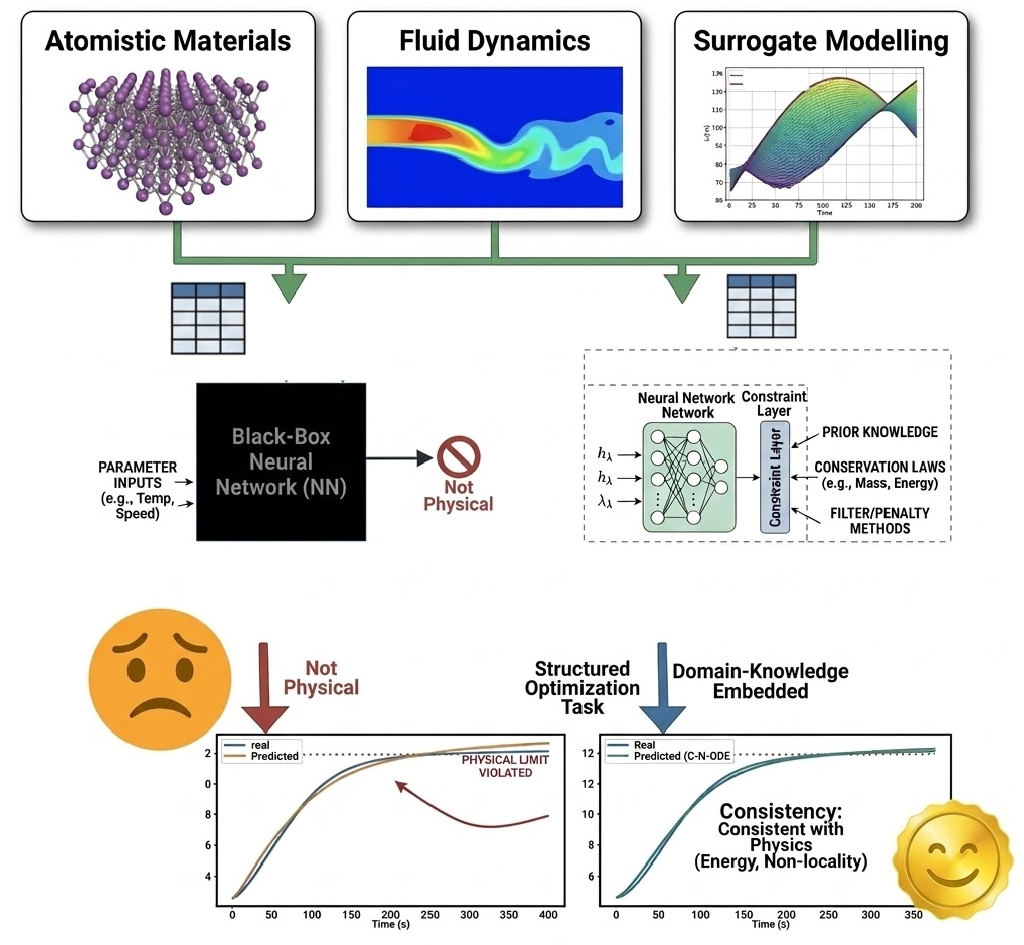
Physical systems obey structural constraints, conservation laws, and governing equations that must remain valid even when models are learnt from data. Thus, we combine differential equation modelling, constrained optimisation, and machine learning to build models that offer high predictive performance while remaining consistent with physical systems.
Learning problems are formulated as structured optimisation tasks in which prior knowledge, physical constraints, and domain expertise are embedded directly into the learning process. This enables robust modelling under limited data availability and provides the theoretical foundation for trustworthy AI methods applied throughout the group’s research activities.
Coelho, C.; Costa, M. F. P.; & Ferr´as, L. L. (2025). A Two-Stage Training Method for Modeling Constrained Systems With Neural Networks. Journal of Forecasting, 44(5), 1785-1805. https://doi.org/10.1002/for.3270
Liebert, A., Palani, A., Rensmeyer, T., Breuer, M., & Niggemann, O. (2024). CNN-based temperature dynamics approximation for burning rooms. IFAC-PapersOnLine, 58(4), 420-425. https://doi.org/10.1016/j.ifacol.2024.07.254
Rensmeyer, T., Multaheb, S., Putzke, J., & Zimmering, B. (2022). Using Domain-Knowledge to Improve Machine Learning: A Survey of Recent Advances. atp magazin, 64(8), 78-84. https://doi.org/10.17560/atp.v63i9.2600
Research Direction 2: Learning Spatio-Temporal Processes
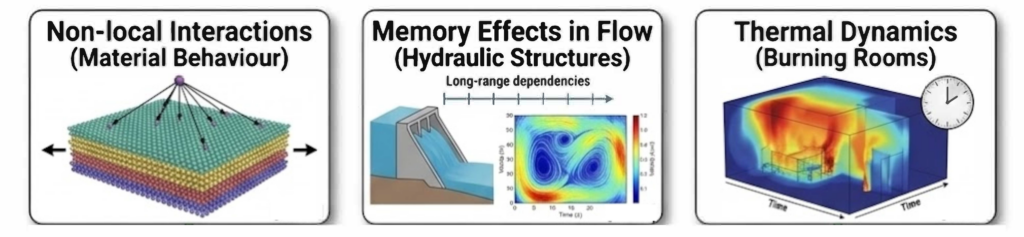
Many physical and engineering systems exhibit memory effects, non-local interactions, and dynamics evolving across multiple temporal scales. Our research develops a range of neural network architecture for sequential dependencies that learn temporal behaviours directly from data: convolutional neural networks for spatial-temporal feature extraction; recurrent neural networks for sequential dependencies; neural differential equations for continuous-depth modelling.
Classical integer-order differential equations often fail to capture long-range temporal correlations, and non-local effects, inherent in physical processes. Thus, our research focuses on fractional calculus and its integration in machine learning models as a unified framework for modelling these complex dynamics.
Fractional formulations provide a mathematically principled way to represent diffusion processes, material behaviour, thermal dynamics, and complex physical interactions that cannot be adequately described by Markovian models.
Coelho, C., Costa, M. F. P., & Ferr´as, L. L. (2025). Neural fractional differential equations. Applied Mathematical Modelling, 144, 116060. https://doi.org/10.1016/j.apm.2025.116060
Coelho, C., Costa, M. F. P., Niggemann, O., & Ferr´as, L. L. (2025). Methodologies for Improved Optimisation of the Derivative Order and Neural Network Parameters in Neural FDE Models. Fractal and Fractional, 9(7), 471. https://doi.org/10.3390/fractalfract9070471
Liebert, A., Palani, A., Rensmeyer, T., Breuer, M., & Niggemann, O. (2024). CNN-based temperature dynamics approximation for burning rooms. IFAC-PapersOnLine, 58(4), 420- 425. https://doi.org/10.1016/j.ifacol.2024.07.254
Eilermann, S., Lüddecke, L., Hohmann, M., Zimmering, B., Oertel, M., & Niggemann, O. (2024, October). A neural ordinary differential equations approach for 2D flow properties analysis of hydraulic structures. In 1st ECAI Workshop on “Machine Learning Meets Differential Equations: From Theory to Applications
Research Direction 3: Generative and Probabilistic AI for Structured Physical Data
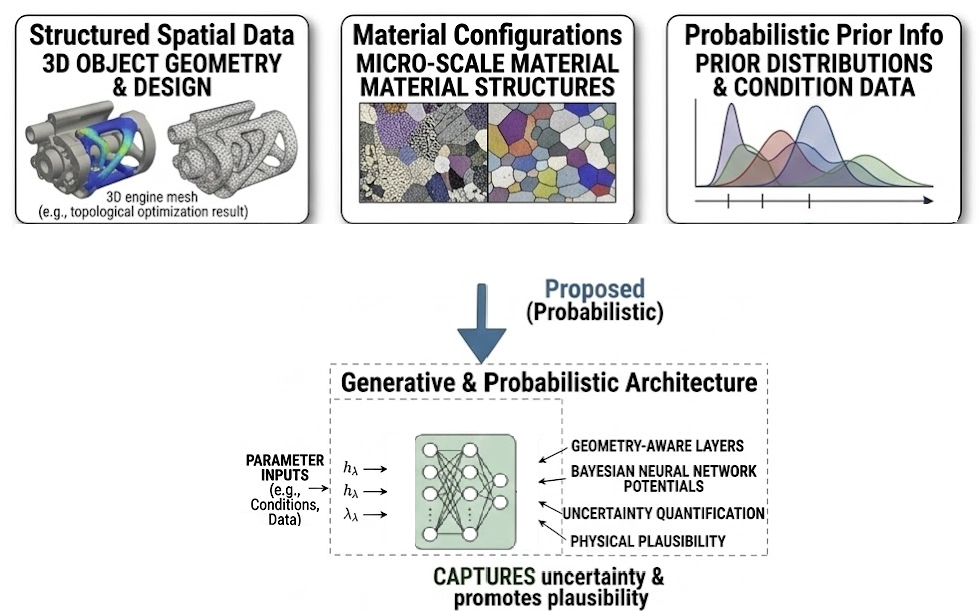
Modern engineering workflows increasingly rely on large volumes of structured spatial and material data. Our research develops generative models to operate on geometries and material configurations while preserving interpretability and physical plausibility. Probabilistic learning methods quantify uncertainty and promote trustworthy inference to support data reconstruction, condition-based generation, and uncertainty-guided learning.
This research direction establishes models as tools for scientific reasoning and design.
Rensmeyer, T., Kramer, D., & Niggemann, O. (2025). On-the-Fly Fine-Tuning of Foundational Neural Network Potentials: A Bayesian Neural Network Approach. arXiv preprint arXiv:2507.13805. https://doi.org/10.48550/arXiv.2507.13805
Rensmeyer, T., & Niggemann, O. (2024). On the convergence of locally adaptive and scalable diffusion-based sampling methods for deep Bayesian neural network posteriors. ArXiv preprint arXiv:2403.08609. https://doi.org/10.48550/arXiv.2403.08609
Boschmann, D., Stieghorst, C., Knezevic, D., Kadri, L., & Niggemann, O. (2024, August). Automation of PGAA spectra analysis with deep learning. In 2024 IEEE 22nd International Conference on Industrial Informatics (INDIN) (pp. 1-8). IEEE. https://ieeexplore.ieee.org/abstract/document/10774320
Hohmann, M., Eilermann, S., Grosmann, W., & Niggemann, O. (2024, September). Design automation: a conditional VAE approach to 3D object generation under conditions. In 2024 IEEE 29th International Conference on Emerging Technologies and Factory Automation (ETFA) (pp. 1-8). IEEE. https://doi.org/10.1109/ETFA61755.2024.10710828
Grosmann, W., Eilermann, S., Rensmeyer, T., Liebert, A., Hohmann, M., Wittke, C. H. A., & Niggemann, O. (2023, December). Position paper on materials design. In AAAI-24 Workshop at the 38th Annual AAAI Conference on Artificial Intelligence; Vancouver, Canada; February 26-27, 2024. arXiv. https://doi.org/10.48550/arXiv.2312.10996
Research Direction 4: AI-Accelerated Simulation, Digital Twins, and Optimal Decision-making
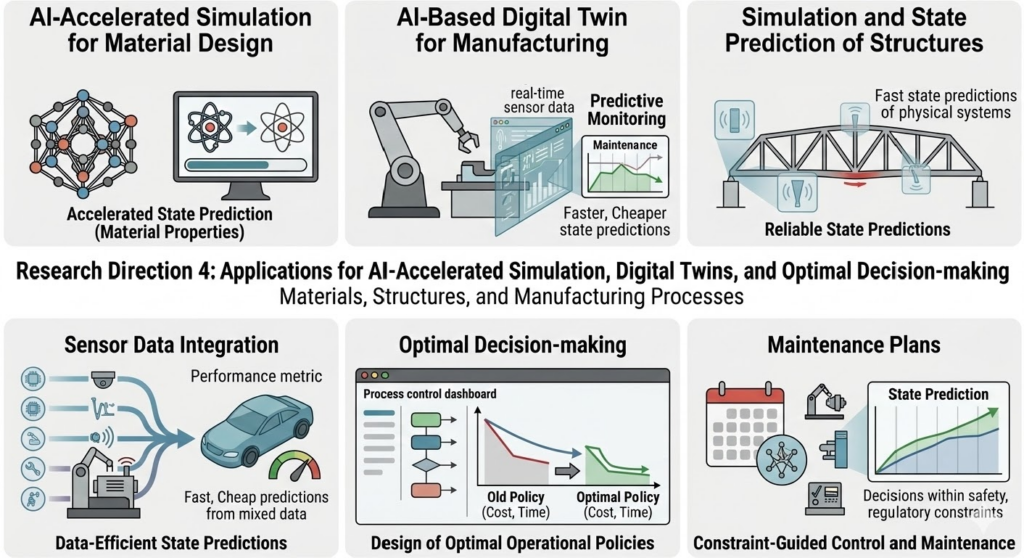
Our research aims to enable AI-based digital twins and predictive monitoring systems for materials, structures, and manufacturing processes. We develop methods to integrate simulated and sensor data, and prior knowledge to perform faster, cheaper, and reliable state predictions of physical systems. This enables the design of control strategies, maintenance plans, and operational policies that respect physical, safety, and regulatory constraints.
Coelho, C., Costa, M. F. P., Ferr´as, L. L., & Niggemann, O. (2026). Neural ODEs for Optimal Control: Learning Continuous Trajectories and Feedback Policies via Adaptive Discretisation. Authorea Preprints. DOI: 10.36227/techrxiv.177138734.49140553/v1
Lüddecke, L., Hohmann, M., Eilermann, S., Tillmann-Mumm, J., Pourabdollah, P., Oertel, M., & Niggemann, O. (2026). WeirNet: A Large-Scale 3D CFD Benchmark for Geometric Surrogate Modeling of Piano Key Weirs. arXiv preprint arXiv:2602.20714. https://arxiv.org/abs/2602.20714
Ili´c, S., Jovanˇcevi´c, N., Kneˇzevi´c, D., Maleti´c, D., Stieghorst, C., Nayak, A., … & Krmar, M. (2025). The use of artificial neural networks for the unfolding procedures in neutron activation measurements. The European Physical Journal A, 61(4), 80. https://link.springer.com/article/10.1140/epja/s10050-025-01555-z
Coelho, C., Hohmann, M., Fern´andez, D., Penter, L., Ihlenfeldt, S., & Niggemann, O. (2025). Data-Driven Temperature Modelling of Machine Tools by Neural Networks: A Benchmark. arXiv preprint arXiv:2510.03261. https://doi.org/10.48550/arXiv.2510.03261
Eilermann, S., Heesch, R., & Niggemann, O. (2025). A Continuous-Time Consistency Model for 3D Point Cloud Generation. arXiv preprint arXiv:2509.01492. https://doi.org/10.48550/arXiv.2509.01492
Liebert, A., Dethof, F., Kesler, S., Niggemann, O. (2024). Automated impact echo spectrum anomaly detection using u-net autoencoder. In ECAI 2024 (pp. 4634-4641). IOS Press. https://pdfs.semanticscholar.org/7e1d/330bd88ebf354699335d56659daffc5085e6
Wittke, C., Liebert, A., Friesen, A., Flatt, H., & Niggemann, O. (2024). Potato-Glow: Utilizing Glow for Vision-Based Anomaly Detection in an Industrial Context: A Comparative Benchmarking Approach. In Jahreskolloquium zur Bildverarbeitung in der Automation (pp. 15-28). Berlin, Heidelberg: Springer Berlin Heidelberg. https://link.springer.com/chapter/10.1007/978-3-662-70997-9_2
Krantz, M., Widulle, N., Nordhausen, A., Liebert, A., Ehrhardt, J., Eilermann, S., Niggemann, O. (2022, October). Flipsi: Generating data for the training of machine learning algorithms for cpps. In Annual Conference of the PHM Society (Vol. 14, No. 1) https://doi.org/10.36001/phmconf.2022.v14i1.3229
Research Projects
KIAAA
The project “KIAAA – An AI Assistant for Training in Automation” develops training software that supports automation professionals with personalized, real-time feedback. Based on adaptive simulations of production processes, AI and machine learning analyze learners knowledge levels and generate tailored learning scenarios. A role model agent provides example automation solutions, while a collaborative environment enables knowledge exchange among learners.

Eilermann, S., Wehmeier, L., Niggemann, O., & Deuter, A. (2023, July). KIAAA: An AI assistant for teaching programming in the field of automation. In 2023 IEEE 21st International Conference on Industrial Informatics (INDIN) (pp. 1-7). IEEE.
DigiMed
The joint research project “Digital Value Chains for Medical Technology Based on the Additive Manufacturing of Patient-Specific Facial Surgical Implants (DigiMed)” aims to ensure sustainable patient care through individually tailored implants. It focuses on developing and demonstrating a prototypical end-to-end digital value chain that uses AI and additive manufacturing to transform medical imaging data directly into patient-specific facial implants.
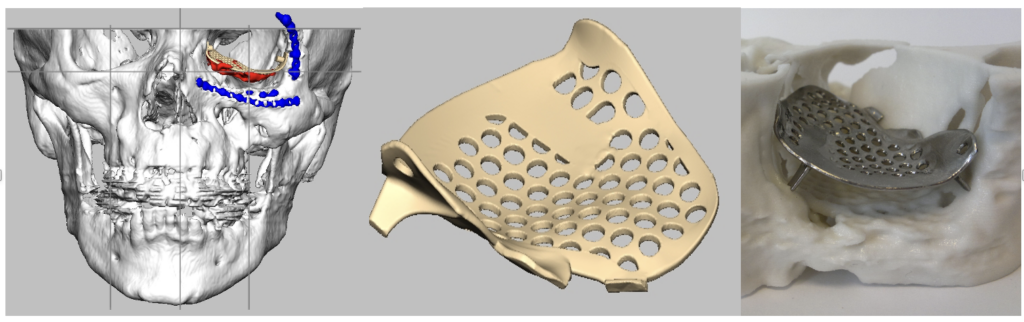
Imgrund, P., Gromzig, P., Böhm, C., Röhrich, L., Lindecke, P., Walter, J., … & Niggemann, O. (2022). Digital work flow and process for additive manufacturing of patient-specific-implants for craniomaxillofacial reconstruction. Transactions on Additive Manufacturing Meets Medicine, 4(S1), 680-680.
LaiLa – Laboratory for Intelligent Lightweight Construction
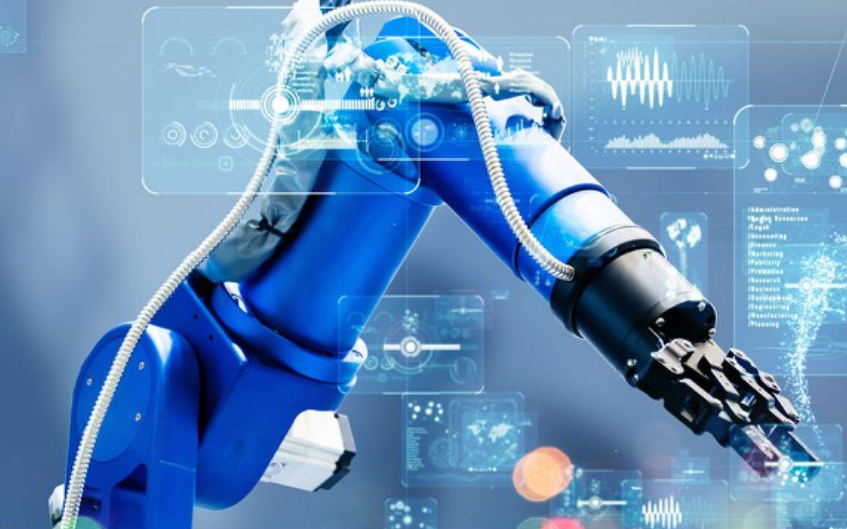
The project addresses largely manual and paper-based production processes in fiber composite lightweight construction, combining symbolic AI and machine learning to enable digital integration, diagnostics, and predictive maintenance.
Eilermann, S., Heesch, R., Niggemann, O. (2025). A Continuous-Time Consistency Model for 3D Point Cloud Generation. arXiv preprint arXiv:2509.01492.
KIBIDZ
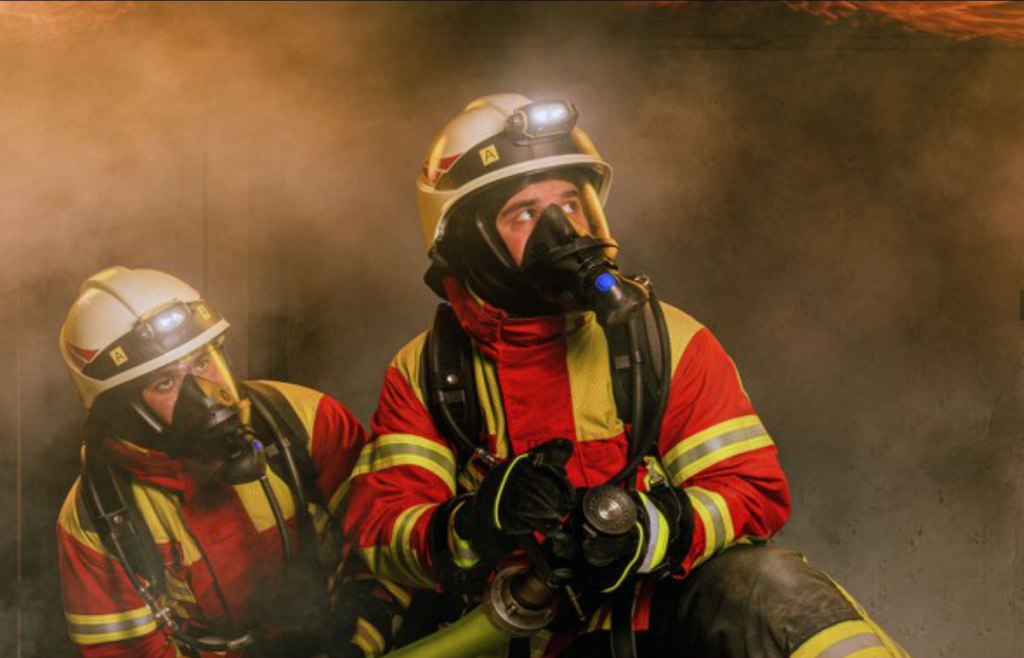
Real-time hazard assessment in building fires requires accurate prediction of smoke propagation, temperature distribution, and structural stability. The project develops a digital twin of burning buildings by integrating simulations, sensor networks, and machine learning methods.
This research is funded by dtec.bw — Digitalization and Technology Research Center of the Bundeswehr, funded by the European Union — NextGenerationEU.
Liebert et al. (2024): Automated Impact Echo Spectrum Anomaly Detection using U-Net Autoencoder, PAIS @ ECAI 2024 Proceedings DOI:10.3233/FAIA241058
AI Accelerated Materials Design
End-user-friendly and trustworthy AI-accelerated materials simulation at the atomic level.
This research project develops uncertainty-guided autonomous workflows for training and fine-tuning machine learning force fields for individual candidate materials by leveraging foundation models and Bayesian neural networks.
This research is funded by dtec.bw — Digitalization and Technology Research Center of the Bundeswehr, funded by the European Union — NextGenerationEU.
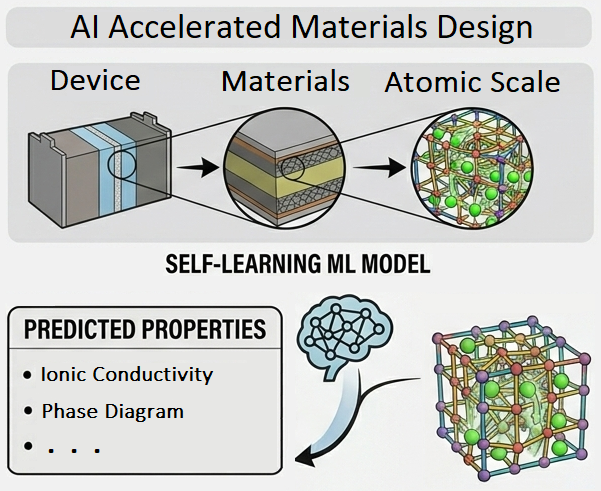
Rensmeyer et al. (2024): High accuracy uncertainty-aware interatomic force modeling with equivariant Bayesian neural networks, Digital Discovery, 3, DOI:10.1039/d4dd00183d
Hyperspectral Unmixing of Physical Data with Prior Knowledge
This dissertation project investigates the hyperspectral unmixing of physical data using machine learning under the integration of prior knowledge. As part of the EvalSpek-ML project, the framework is applied to Prompt Gamma Activation Analysis (PGAA) spectra: a novel dual‑head autoencoder trained on progressively realistic synthetic data jointly reconstructs backgrounds and predicts full elemental compositions. By embedding known reference spectra in linear and polynomial decoders and enforcing non-negativity and sum-to-one constraints, the model achieves unprecedented accuracy in estimating iron-chlorine abundances from PGAA spectra.

Boschmann et al. (2024): Automation of PGAA spectra analysis with deep learning, INDIN 2024, DOI:10.1109/INDIN58382.2024.10774320
Letzte Änderung: 8. April 2026