Contact: Alexander Windmann
Cyber-physical systems generate large volumes of diverse data under changing operating conditions. Purely data-driven methods are often not robust enough and transfer poorly to new applications. Our research program combines machine learning with physical system knowledge to develop methods that are reliable and transferable in industrial practice. The six research topics range from monitoring and analyzing technical systems, through physically grounded modeling, to automating design and engineering workflows.
1) Robust and Reliable Machine Learning for Cyber-Physical Systems
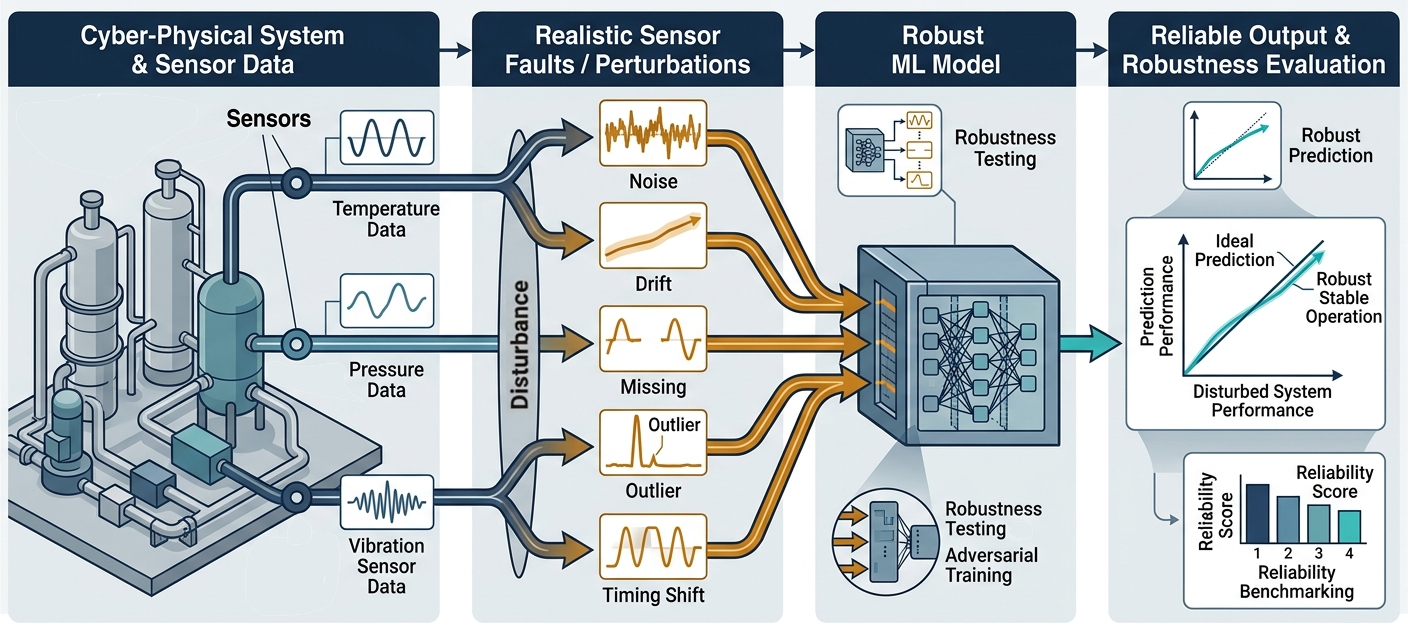
Machine learning methods for cyber-physical systems need to remain dependable under real operating conditions. Research in this area focuses on models that cope with noise, drift, missing values, and changing operating regimes. The aim is not only high performance in controlled experiments, but stable behavior in industrial use.
A second focus is the systematic evaluation of robustness. This includes meaningful benchmarks, reproducible experiments, and a careful analysis of how modeling choices affect reliability in practice. Robustness is therefore treated as a measurable engineering property that can be assessed and improved.
Related Publications
- Alexander Windmann, Henrik Steude, Daniel Boschmann, Oliver Niggemann: Quantifying Robustness: A Benchmarking Framework for Deep Learning Forecasting in Cyber-Physical Systems, 30th IEEE International Conference on Emerging Technologies and Factory Automation (ETFA), Porto, Portugal, 2025. https://doi.org/10.1109/ETFA65518.2025.11205527
- Joshua Schraven, Alexander Windmann, Oliver Niggemann: MAWIFlow Benchmark: Realistic Flow-Based Evaluation for Network Intrusion Detection, 12th International Conference on Information Systems Security and Privacy, Marbella, Spain, 2026. https://arxiv.org/abs/2506.17041
- Daniel Vranješ, Jonas Ehrhardt, René Heesch, Lukas Moddemann, Henrik Steude, Oliver Niggemann: Design Principles for Falsifiable, Replicable and Reproducible Empirical Machine Learning Research, The 35th International Conference on Principles of Diagnosis and Resilient Systems, Vienna, Austria, 2024. https://doi.org/10.4230/OASIcs.DX.2024.7
2) Condition Monitoring, Anomaly Detection, and Root-Cause Analysis
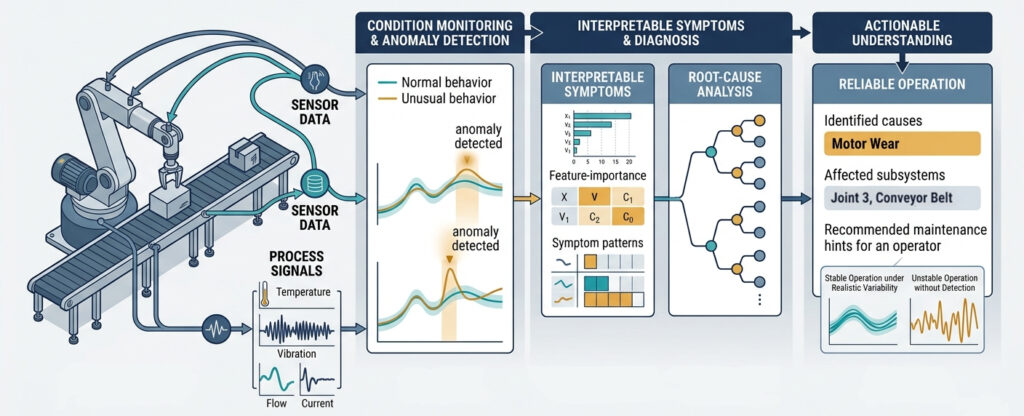
Cyber-physical systems generate large amounts of heterogeneous process and sensor data during operation. Research in this area develops learning-based methods for condition monitoring and anomaly detection that identify unusual behavior early and support the reliable operation of complex technical systems. The focus is on methods that remain useful in realistic industrial settings.
A central idea is to connect detection and diagnosis more closely. Instead of treating anomalies as isolated alerts, the goal is to derive interpretable symptoms and support root-cause-oriented analysis. This creates a direct path from raw sensor data to actionable system understanding.
Related Publications
- Lukas Moddemann, Henrik Sebastian Steude, Alexander Diedrich, Ingo Pill, Oliver Niggemann: Extracting Knowledge using Machine Learning for Anomaly Detection and Root-Cause Diagnosis, 29th IEEE International Conference on Emerging Technologies and Factory Automation (ETFA), Padova, Italy, 2024. https://doi.org/10.1109/ETFA61755.2024.10710647
- Henrik Sebastian Steude, Lukas Moddemann, Alexander Diedrich, Jonas Ehrhardt, Oliver Niggemann: Diagnosis driven Anomaly Detection for Cyber-Physical Systems, 12th IFAC Symposium on Fault Detection, Supervision and Safety for Technical Processes (SAFEPROCESS), Ferrara, Italy, 2024. https://doi.org/10.1016/j.ifacol.2024.07.186
- Mark Tappe, Lukas Moddemann, Henrik Steude et al.: A supervised AI-based toolchain for anomaly detection, diagnosis, and reconfiguration for the life-support system of the COLUMBUS module of the ISS, CEAS Space Journal, 2025. https://doi.org/10.1007/s12567-025-00654-3
3) Structure-Aware Learning and Virtual Sensing
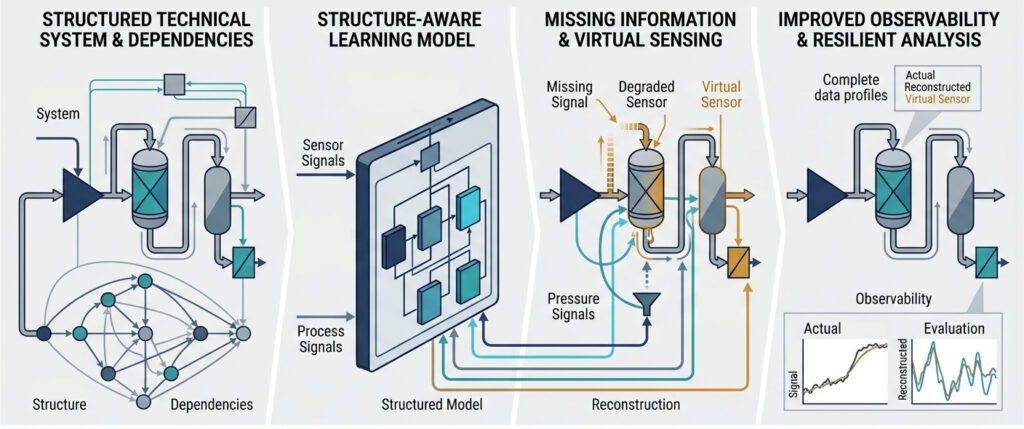
Technical systems are modular, hierarchical, and shaped by dependencies between components and signals. Research in this area develops learning methods that make explicit use of this structure. This leads to models that are easier to interpret, better aligned with real systems, and more useful for industrial analysis tasks.
This topic also includes methods that reconstruct missing information from related measurements and derive virtual sensors from existing signals. Such approaches improve observability and make data-driven analysis more resilient when instrumentation is incomplete or individual sensors degrade.
Related Publications
- Jonas Ehrhardt, Phillip Overlöper, Dainel Vranjes, Henrik Sebastian Steude, Alexander Diedrich, Oliver Niggemann: Using Modular Neural Networks for Anomaly Detection in Cyber-Physical Systems, 29th IEEE International Conference on Emerging Technologies and Factory Automation (ETFA), Padova, Italy, 2024. https://doi.org/10.1109/ETFA61755.2024.10711115
- Phillip Overlöper, Lukas Moddemann, Nemanja Hranisavljevic, Alexander Windmann, Oliver Niggemann: Discretization of CPS Time Series with Neural Networks, 29th IEEE International Conference on Emerging Technologies and Factory Automation (ETFA), Padova, Italy, 2024. https://doi.org/10.1109/ETFA61755.2024.10710901
- Björn Ludwig, Jonas Ehrhardt, Oliver Niggemann: Creating Virtual Sensors Using Neural Networks, 30th IEEE International Conference on Emerging Technologies and Factory Automation (ETFA), Porto, Portugal, 2025. https://doi.org/10.1109/ETFA65518.2025.11205672
4) Machine Learning for Dynamical Systems
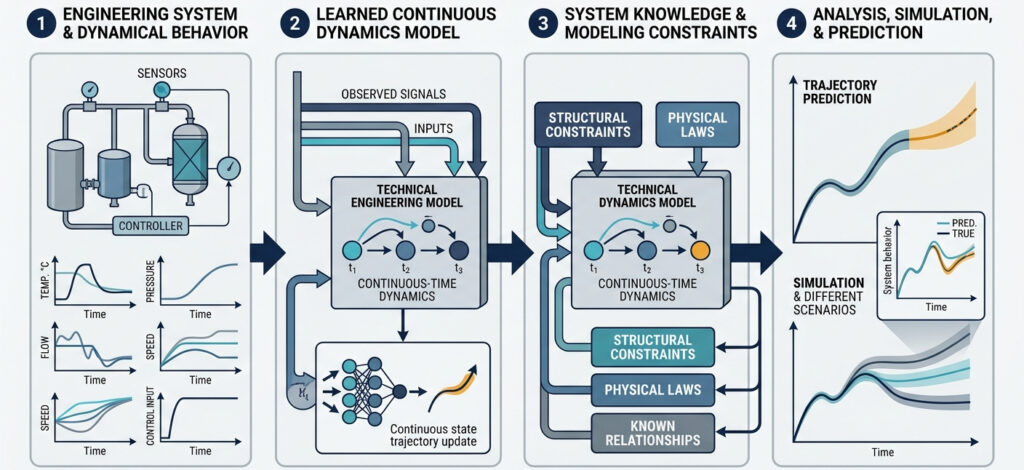
Many engineering processes are governed by continuous dynamics, external inputs, and nonlinear temporal behavior. Research in this area develops learning methods that model these characteristics more directly, including continuous-time approaches, neural differential equations, and related models for technical systems.
A central goal is to combine data-driven learning with prior knowledge about system behavior. This supports models that generalize better, remain more interpretable, and are more useful for analysis, simulation, and prediction in engineering applications.
Related Publications
- Bernd Zimmering, Cecilia Coelho, Vaibhav Gupta, Maria Maleshkova, Oliver Niggemann: Breaking Free: Decoupling Forced Systems with Laplace Neural Networks, European Conference on Machine Learning and Principles and Practice of Knowledge Discovery in Databases (ECML PKDD), Porto, Portugal, 2025. https://doi.org/10.1007/978-3-032-06109-6_15
- Bernd Zimmering, Jan-Philipp Roche, Oliver Niggemann: Enhancing Nonlinear Electrical Circuit Modeling with Prior Knowledge-Infused Neural ODEs, 29th IEEE International Conference on Emerging Technologies and Factory Automation (ETFA), Padova, Italy, 2024. https://doi.org/10.1109/ETFA61755.2024.10711112
- Sebastian Eilermann, Lisa Lüddecke, Michael Hohmann, Bernd Zimmering, Mario Oertel, Oliver Niggemann: A Neural Ordinary Differential Equations Approach for 2D Flow Properties Analysis of Hydraulic Structures, 1st ECAI Workshop on Machine Learning Meets Differential Equations: From Theory to Applications, Santiago de Compostela, Spain, 2024. https://proceedings.mlr.press/v255/eilermann24a.html
5) Foundation Models for Engineering Workflows
Large language models and related foundation models open new possibilities for engineering work. Research in this area studies how such models perform on realistic engineering tasks and where they can support documentation, instruction generation, and knowledge-intensive assistance in technical settings.
The emphasis is on practical value rather than generic chatbot performance. This includes task-oriented evaluation, domain-specific problem settings, and the combination of language-based methods with other AI techniques when this creates clear benefits in engineering workflows.
Related Publications
- René Heesch, Sebastian Eilermann, Alexander Windmann, Alexander Diedrich, Oliver Niggemann: Evaluating Large Language Models for Real-World Engineering Tasks, Australasian Joint Conference on Artificial Intelligence 2025, Canberra, Australia, 2025. https://doi.org/10.1007/978-981-95-4969-6_5
- Frederic Meyer, Lennart Freitag, Sven Hinrichsen, Oliver Niggemann: Potentials of Large Language Models for Generating Assembly Instructions, 29th IEEE International Conference on Emerging Technologies and Factory Automation (ETFA), Padova, Italy, 2024. https://doi.org/10.1109/ETFA61755.2024.10710806
- Niklas Widulle, Frederic Meyer, Oliver Niggemann: Generating Assembly Instructions Using Reinforcement Learning in Combination with Large Language Models, 22nd IEEE International Conference on Industrial Informatics (INDIN), Beijing, China, 2024. https://doi.org/10.1109/INDIN58382.2024.10774545
6) AI for Design Automation and 3D Modeling
Machine learning can support engineering design by exploring design spaces, generating variants under constraints, and linking geometric representations with functional requirements. Research in this area connects generative methods with design automation and three-dimensional modeling for technical applications.
The goal is not only to generate shapes, but to support structured engineering workflows. This makes AI-based design assistance relevant for applications in which geometry, constraints, and manufacturability need to be considered together.
Related Publications
- Michael Hohmann, Sebastian Eilermann, Willi Großmann, Oliver Niggemann: Design Automation: A Conditional VAE Approach to 3D Object Generation under Conditions, 29th IEEE International Conference on Emerging Technologies and Factory Automation (ETFA), Padova, Italy, 2024. https://doi.org/10.1109/ETFA61755.2024.10710828
- Michael Hohmann, Adili Yiming, Lars Penter, Steffen Ihlenfeldt, Oliver Niggemann: A Data-Driven Approach for Automating the Design Process of Deep Drawing Tools, The 13th International Conference and Workshop on Numerical Simulation of 3D Sheet Metal Forming Process (NUMISHEET), Munich, Germany, 2025. https://doi.org/10.1088/1742-6596/3104/1/012061
- Sebastian Eilermann, René Heesch, Oliver Niggemann: ConTiCoM-3D: A Continuous-Time Consistency Model for 3D Point Cloud Generation, International Conference on 3D Vision 2026, Vancouver, Canada. https://arxiv.org/abs/2509.01492
Selected Current Projects
dtec.bw: SmartShip – Digital Twins for Intelligent Ships and Ship Fleets
SmartShip explores how digital twins, artificial intelligence, and machine-learning methods can support maritime operations. To this end, heterogeneous data sources such as navigation, camera, and machinery data are integrated to improve the analysis of ship and fleet operations, enable early anomaly detection, and support data-driven decision-making.
dtec.bw: KIPro – AI-Based Assistance System Platform for Complex Production Processes in Mechanical and Plant Engineering
KIPro develops AI-based assistance systems that provide employees with targeted support throughout the entire work process. This includes the automatic adaptation of system configurations, early error detection, and flexible production support that takes both employee skills and workload into account.
DFG: Data-Driven Tool Tryout in Sheet Metal Forming
This project develops machine-learning methods for data-driven tool tryout in sheet metal forming. Its aim is both to learn the design of active tool surfaces and machine parameters from data and to support, and gradually automate, a process that has so far relied heavily on expert experience.
BMFTR: BioMLAgrar-2 – Biodiversity, Machine Learning and Agriculture
BioMLAgrar-2 investigates how data-driven analysis and forecasting models can be used to support biodiversity management in agriculture. A particular focus lies on ML methods that enable meaningful models even when data availability is limited and that incorporate domain expertise into the modelling process.
Letzte Änderung: 6. April 2026