Welcome to the Container-based High Performance Computing Center!
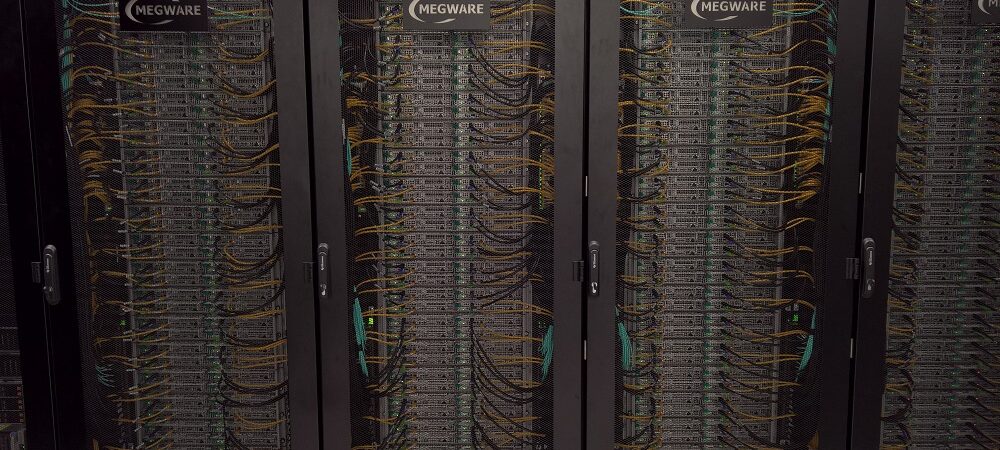
In the following, you find information on the Container-based High Performance Computing Center (CBRZ) at HSU which is administrated by the chair for high performance computing.
If you have any questions, feel free to contact [email protected].
For Newbies
- Which compute systems are available at CBRZ?
Currently, the CBRZ hosts- the supercomputer HSUper, which features O(580) compute nodes for compute- and data-intensive workloads. HSUper is currently ranked 339 in the TOP500 list (June 2022).
- the Interactive Scientific Computing Cloud (ISCC). The ISCC aims to fill the gap for users with specific needs that cannot be containerized as well as users with workloads that cannot be satisfied by existing local machines and do not yet require the entire power of HSUper.
- a two-node Cerebras CS-3 system. This is a cutting-edge AI-focused supercomputer, designed for HPC applications, ML training, and using large language models. This system is powered by Cerebras’ third-generation Wafer Scale Engines. More information about the installed Cerebras Systems at HSU can be found in this online documentation.
- How can I get access to the computational resources?
- If you are a member of HSU: Please apply for HSUper access using the following form (available on campus/VPN only, login with RZ credentials) or this form for the ISCC. Or navigate the ticket system website to find further forms: Ticket Templates » CBRZ » CBRZ: HPC Access Registration or CBRZ: ISCC Resources & Administration Access Registration
- If you are not a member of HSU and if you are linked to HSU through a collaborative project with HSU partners: please file a guest account form together with the respective HSU partner in charge. Afterwards, apply for HPC access (same workflow from here as for HSU members). Please note that you will need to sign a user agreement. It will be provided to you during the process.
- In all other cases: please contact the CBRZ team to check for HPC access possibilities.
For Users
More information on HPC competences (workshops, tutorials, material, etc.) can be found on the websites of the HPC Portal, established by the project hpc.bw funded by dtec.bw – Digitalization and Technology Research Center of the Bundeswehr. dtec.bw is funded by the European Union – NextGenerationEU.
CBRZ Infrastructure
The CBRZ consists of four 20′ containers housing twelve 19″ racks, which accommodate two high-performance clusters and a private cloud solution:
HSUper is located in ten racks of the CBRZ. They currently contain:
- 571 liquid-cooled computing nodes,
- 5 fat-memory (1TB) liquid-cooled computing nodes,
- 5 GPU nodes (two NVIDIA Tesla A100 PCIe 40GB HBM2 per node),
- 4 GPU nodes (8 NVIDIA L40S per node)
- 1 PB BeeGFS storage,
- 1 PB CEPH storage,
- 1.2 PB ZFS backup storage,
- networking & uninterruptible power supply hardware,
- additional hardware like the ISCC (see below).
One rack contains up to 92 computing nodes and 5 switches.
Each node consists of:
- 2 (dual-socket) Intel Xeon Scalable Platinum 8360Y, 36 Core @ 2.40 GHz
- 256 GB RAM (fat & L40S GPU nodes: 1TB)
- NVIDIA InfiniBand HDR100 (non-blocking)
A heat pump system enables sustainable reuse of hot liquids for building heating.
The Interactive Scientific Computing Cloud (ISCC) consists of 14 hosts in total located in the HSUper racks. 13 hosts have the same or similar hardware specifications as HSUper. One host has the specification of an HSUpreme fat memory node. The interconnect is different from the high-performance clusters and capable of 50Gb/s over Ethernet instead of InfiniBand HDR100 or NDR200. The ISCC is located in the same container building as HSUper. The ISCC has its own flash-only storage solution with a physical netto capacity of 300TB.
- HSUper-like GPU hosts: 3 hosts each equipped with 2 Intel Icelake sockets and 2TB local scratch storage, and at least 1 TB RAM; each socket features a Intel(R) Xeon (R) Platinum 8360Y processor with 32 cores @ 2.50 GHz, yielding a total of 64 cores per host.
- 2 hosts equipped with 8 NVIDIA A30 (24GB) GPUs.
- 1 host equipped with 8 NVIDIA L40S (48GB) GPUs and twice the memory of an HSUper GPU node totaling in 2 TB of RAM.
- HSUper-like hosts: 10 hosts each equipped with 4 GB RAM per CPU core (256 GB RAM) and 2 Intel Icelake sockets; each socket features a Intel(R) Xeon (R) Platinum 8360Y processor with 32 cores @ 2.50 GHz, yielding a total of 64 cores per host.
- HSUpreme-like host: 1 host equipped with 12 GB RAM per CPU core (2304 GB RAM) and 2 (dual-socket) AMD EPYC 9655 with 96 cores @ 2.6 GHz, yielding a total of 192 cores per host.
The Cerebras System is a two-node CS-3 system with two Wafer Scale Engines (WSE-3). Built on a 5nm process, the WSE-3 integrates 900,000 AI-optimized cores onto a single wafer. The architecture supports both AI (up to 240 billion parameters) and HPC workloads. The Cerebras System is located in the same container building as HSUper, in two additional racks.
HPC-related Projects
In the following, you find a list of projects that are related to CBRZ and its computational resources:
- hpc.bw: Competence Platform for Software Efficiency and Supercomputing (Prof. Neumann, supported by dtec.bw)
- MaST: Macro/Micro-Simulation of Phase Decomposition in the Transcritical Regime (Prof. Neumann, supported by dtec.bw)
- SuMo: Sustainability for Molecular Simulation in Process Engineering (Prof. Neumann, supported by DFG)

Letzte Änderung: 11. November 2026