Pipetting is a central task in laboratory work, and even small errors can influence experimental results, reduce efficiency, and increase costs. The Smart Pipetting project focuses on using sensor data to provide direct feedback to the operator and to lead to a deeper understanding of the pipetting process by developing models using machine learning/ deep learning.
A key goal of the project is to better identify what and how the liquid is being pipetted and to use this information to adapt pipetting parameters automatically. For example, by detecting differences between liquids and recognizing errors, electronic pipettes could adjust their settings to improve performance and warn the user when a mistake has been made. Another objective is to make the pipetting process more traceable and better documented.
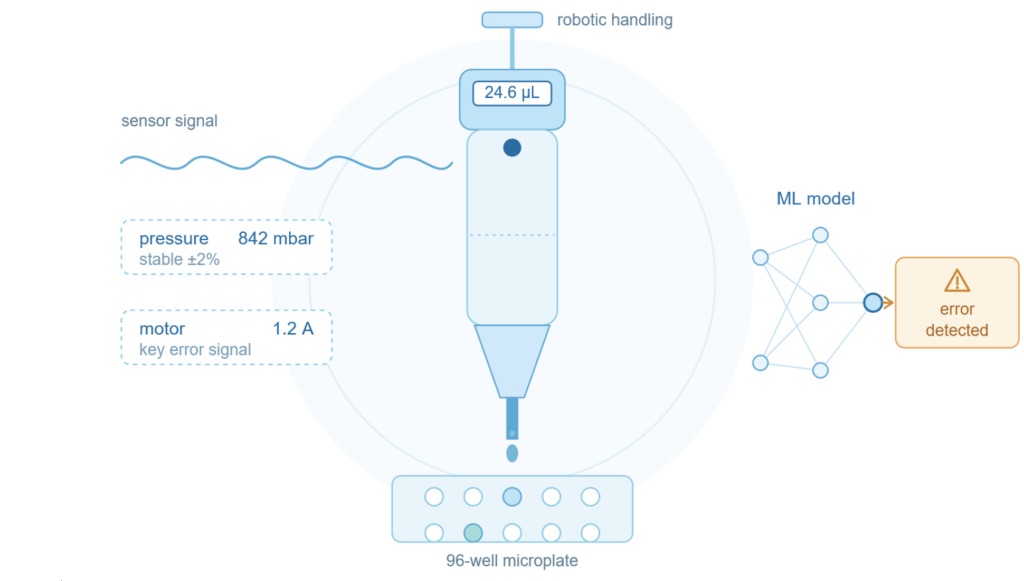
To achieve this, the project uses electronic pipettes equipped with sensors that acquire measurements such as motor current, pressure, and related process signals. These data streams make it possible to analyse pipetting behaviour in detail.
To make such analysis possible, dedicated experiments are designed and carried out to generate large amounts of data. These experiments systematically vary factors such as liquid type, error conditions, and other relevant parameters in order to create a comprehensive dataset for model development and evaluation. By using robotics, we can reproducibly acquire the measurements and achieve high throughput.
The generated dataset is used to apply different analytical methods, including machine learning and deep learning, to generate predictions from the recorded data. For instance, we trained a model to use the motor current of the pipette to detect air aspiration errors.
This project is realized with the cooperation of Eppendorf Liquid Handling GmbH, a leading manufacturer for laboratory supplies such as pipettes.
Publications

Marcel Von Lehe, Udo Van Stevendaal, Simon Zum Felde, Maria Maleshkova
IEEE International Symposium on Artificial Intelligence for Instrumentation and Measurement (AI4IM)
Letzte Änderung: 7. August 2026