About:
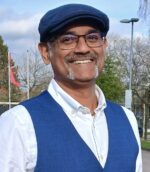
Some people pick up on signals. Many never notice what they are missing. Nilesh Madhu has made a career of it: from understanding where it comes from and what information it carries, to how algorithms can turn the raw signal into something that helps people.
Today he holds the Chair for Signal Processing for Medical Applications (SigMA) at the Helmut-Schmidt-Universität/Universität der Bundeswehr Hamburg and is a part-time professor for audio, speech and signal processing at Ghent University, Belgium, where he heads the ASPIRE group. His work sits at the intersection of signal processing and machine learning, with a special focus on medical applications: from the subtle and not-so-subtle signals of the human body to technologies that listen, enhance, separate and assist.
Before taking up his chair, Madhu was granted his Dr.–Ing. degree (summa cum laude) from the Ruhr-Universität Bochum in 2009, where his dissertation explored algorithms for the localisation and separation of acoustic sources using microphone arrays. A Marie-Curie fellowship then took him to KU Leuven, where he gained expertise in hearing prostheses and biomedical signal analysis — research that still runs through much of what SigMA does today.
In between, he spent time in industry at NXP Semiconductors as principal scientist (and, he insists, “resident genius” — unfortunately not an official designation, but one he has held with the seriousness of an official one) in the Mobile Audio Solutions product line. There, he and his team developed beyond state-of-the-art audio and speech enhancement algorithms that have since shipped in flagship smartphones from major OEMs. So yes: his work may already be in your pocket — in fact, in this very one, listening politely.
With SigMA, he would like to investigate how the techniques he has honed — on microphones, on mobile devices, on hearing prostheses — can do something even more meaningful: develop signal-processing and machine-learning technologies of real help to society.
Through it all, he reminds himself: “With great power comes great responsibility”.
Letzte Änderung: 10. November 2026