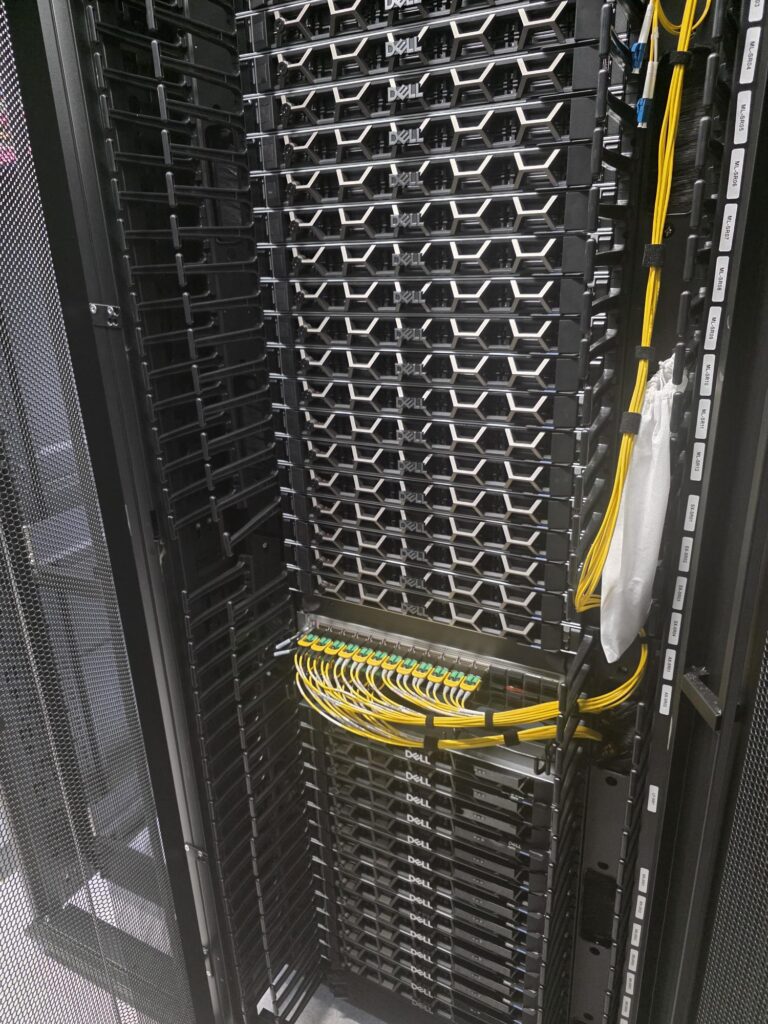
Helmut Schmidt University has acquired a two-node Cerebras CS-3 system. This is a cutting-edge AI-focused supercomputer, designed among other HPC applications also for training and using large language models. This system is powered by Cerebras’ third-generation Wafer Scale Engines, delivering an FP16 peak performance of 125 PFLOP/s through 900 000 for sparse linear algebra optimized compute cores and utilizing 44 GB on-chip SRAM per CS-3. The two-node system supports models with up to 240 billion parameters. For more information, see Cerebras’ official website: https://www.cerebras.ai
Unlike traditional HPC clusters that employ multiple chips from a single wafer, the CS-3 uses the entire wafer to create one large chip. Although designed with ML applications in mind, the system can also be used for traditional HPC workloads such as computational fluid dynamics (CFD) simulations. However, keep in mind that existing HPC software projects require a re-design to run efficiently on the new hardware and software stack (e.g. Cerebras Software Language (CSL) and CSL compilers). In contrast, ML frameworks such as PyTorch and TensorFlow are already supported, making it significantly easier to transition to the CS-3.
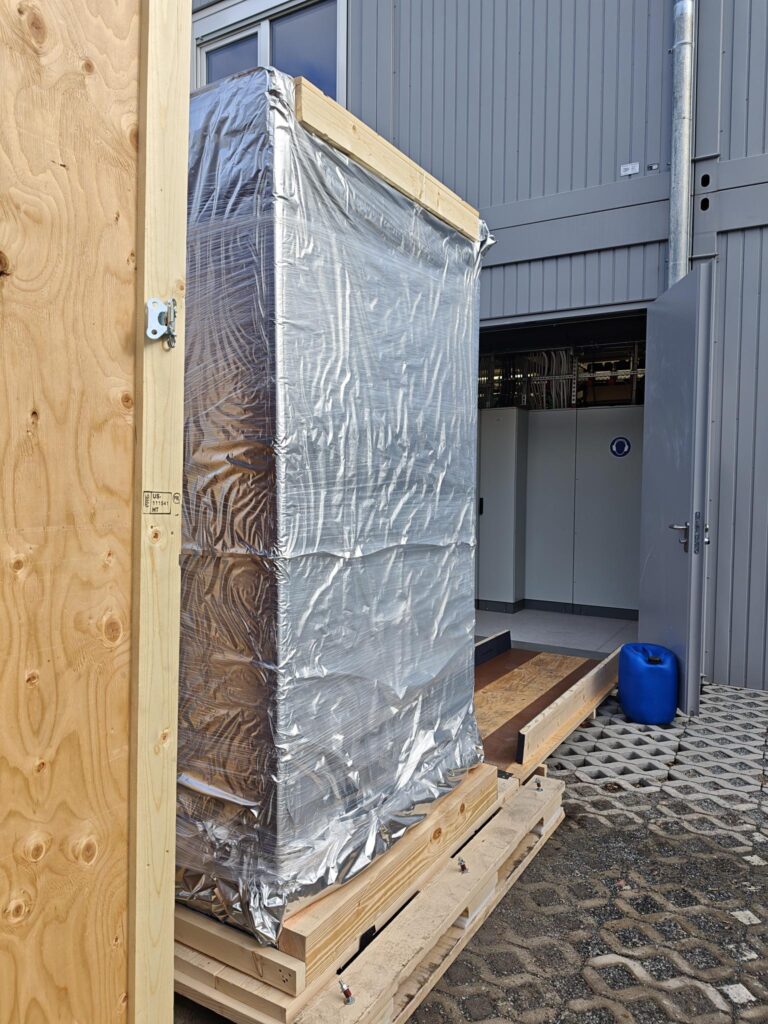
In the last week of February, two Cerebras racks were moved into our Container-Based Computing Center (CBRZ), marking the beginning of the installation process. Over the next weeks, more work will be performed on the hydraulic systems to ensure a stable environment and sufficient cooling for the CS-3 supercomputer. This work will result in a temporary shutdown of HSUper. We aim to have the CS-3 units up and running for beta testers in May 2026.