From 18 to 22 August 2026, Marie Rathmann and I (Alexander Kolling) had the opportunity to attend at the European Conference on Educational Research (ECER) in Tampere, Finland, organised by the European Educational Research Association (EERA). The conference followed the Theme “Knowing and Acting: The changing conditions and potentials of education research”, bringing together researchers from a remarkably range of educational research fields.
To get a better feeling of what large means: 6.619 participants from 83 countries attended the ECER 2026, making it the largest ECER in EERA’s history and also the largest academic conference we’ve ever attended. With around 1.050 sessions, the conference offered an enormous variety of opportunities to present research, discuss current developments and connect across disciplinary and national boundaries. Of course, Marie Rathmann and I were among the 6.800 applications for a presentation, and we were fortunate enough to be accepted (out of the total of 915 reviewers) with the topic Learning through Communities of Practice in Interdisciplinary High Performance Computing: An Adult Education Perspective”.
The presentation focused on how learning and educational processes emerge within HPC communities. Using first insights from surveys and problem centred interviews, we explored how HPC competences are acquired though research practice, problem solving and community based knowledge sharing. The interviews also provided first empirical indications that can be related to the theoretical framework of Communities of Practice (by Etienne Wenger). In particular, shared problem solving, the exchange of experiential knowledge, and the gradual development of expertise through participation point towards learning as a social and practice based process. The main finding of our research by this point can be summarised as followed:
- HPC is an emerging and dynamic field with considerable potential, yet it remains largely unexplored from an adult education perspective.
- HPC Education remains weakly grounded pedagogically. Adult Education could provide systematic frameworks for understanding, structuring, and supporting learning processes in HPC.
- The research potential remains open: How can HPC resources benefit adult education research, and which new research questions might they be enable?
While HPC was new to many participants, other topics were not. Themes surrounding Communities of Practice had featured prominently in several previous sessions, creating strong continuity here. Besides substantive presentations, conferences thrive on international exchange, cultural events and the encounters we had. For that, we would like to share some impressions with you.
The Conference started with a particularly impressive keynote by Pigga Keskitalo about “Ecologies of Knowledge and the Future of Teaching: Sámi Education in Times of Transition.” Keskitalo, among others Professor of Education at the University of Lapland, explored Sámi education through Indigenous knowledge systems, land based learning, language, community and intergenerational responsibility. The keynote was particularly impressive in its challenge to standardized understandings of knowledge and education and its emphasis on knowledge as contextual, relational and co-produced.und and addressing the wide range of application areas. In addition, the participants were given an overview of the container based computing centre (CBRZ) familiarizing them with HSUper and introducing the soon expected upgrade, HSUpreme. This session concluded with an ice-breaking session among the participants. The second half of day one was focused on giving the participants hands-on experience in working with HSUper through the workshop tasks, which are available on the HPC portal (Training | HPC Portal). Following the introduction to accessing HSUper and navigating the Linux terminal, participants got to explore topics of data transfer, understanding the storage systems and the underlying hardware architecture towards the end of day one.
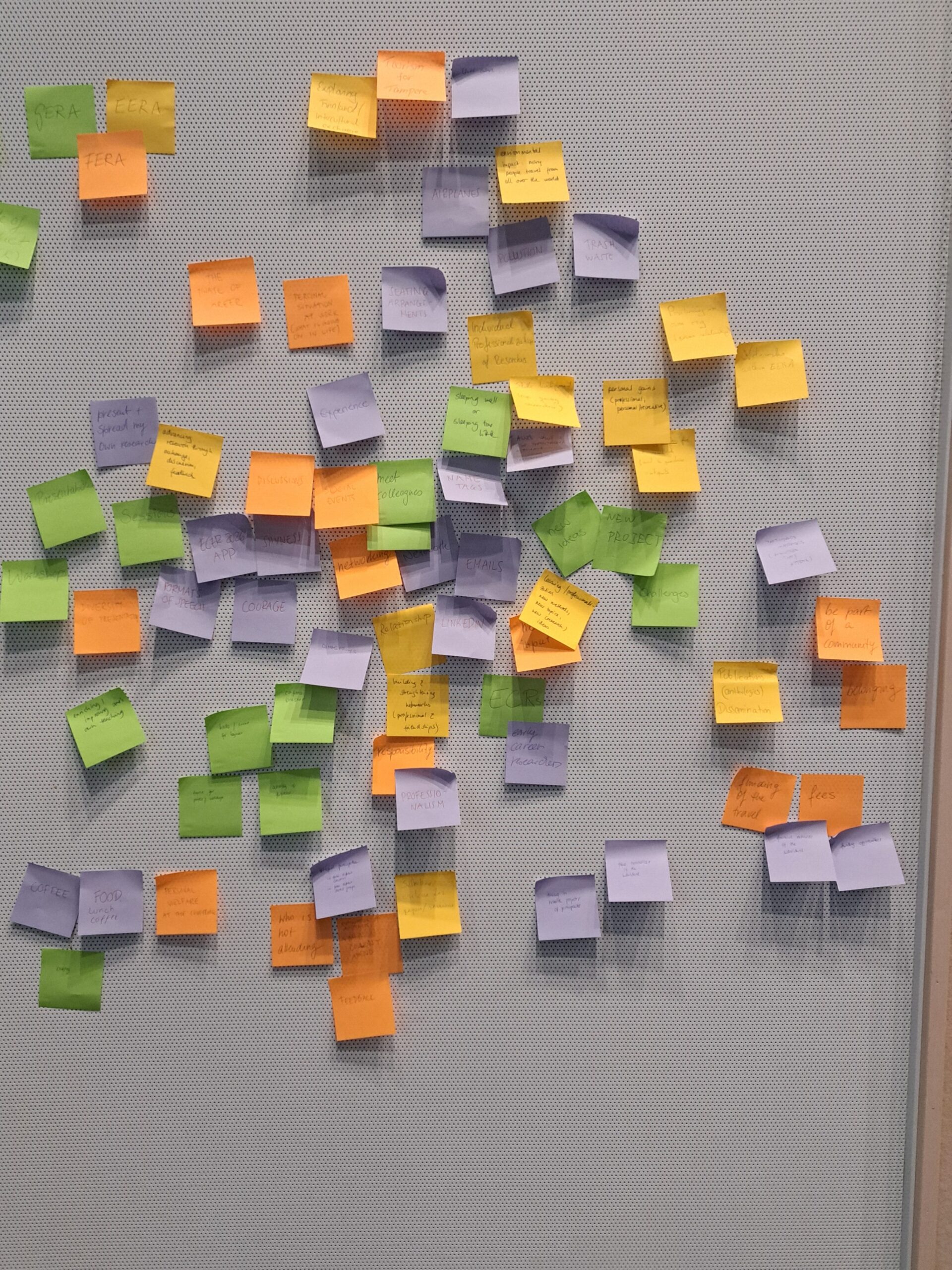
I also had the opportunity to participate in a session by Maria Kontradjuk, which took more hands on approach to qualitative research methods. Instead of simply discussing methods theoretically, participants were able to try out approaches from Situational Analysis (by Adele Clarke) themselves and mapped factors in context of the anticipated influence and impact the conference has on its participants.This provided a fascinating opportunity to explore how complex social phenomena can be visualised, related and analysed through different forms of mapping.
Overall, ECER 2026 was an impressive combination of international exchange, methodological inspiration and opportunities to position the HPC research at HSU within the broader field of educational research. It was especially valuable to see how questions around learning, technology, knowledge and research are being discussed from such different perspectives, and to bring the rather specialised topics of HPC Education into that conversation.