Microbially Induced Carbonate Precipitation (MICP) is a biogeochemical process in which microbial activity modifies the chemical conditions of an aqueous medium, notably by increasing pH and dissolved carbon species, thereby inducing the precipitation of carbonate minerals. This approach has significant applications in subsurface engineering, such as sealing cracks in degraded well cement for oil and gas wells, stabilizing soils, and constructing underground barriers to reduce aquifer permeability. However, implementing MICP in heterogeneous porous media, such as layered soils or fractured rocks, remains a challenge due to uneven microbial and reactant distribution. The OPTIMIC project aims to optimize MICP application in these complex environments by introducing biopolymers to improve fluid distribution, enhance biomineralization, and ensure controlled carbonate precipitation. Due to their high viscosity and shear-thinning properties, biopolymer-based fluids facilitate targeted injection. The project involves screening and selecting bacterial strains capable of efficiently inducing carbonate precipitation, along with compatible biopolymers that support microbial activity and mineral formation. To achieve these objectives, experiments will be conducted at multiple scales, from microfluidic setups and batch reactors to decimeter-scale columns and meter-scale 2D tanks packed with real sediments. These experimental studies will be complemented by numerical simulations spanning from pore-scale models to Darcy-scale flow processes, enabling a comprehensive understanding of MICP mechanisms. Given the complexity and multi-scale nature of the process, this French-German collaboration integrates experimental and modeling approaches to develop robust and scalable solutions for subsurface engineering. This synergy will advance fundamental research while fostering practical applications of MICP in environmental and geotechnical contexts.
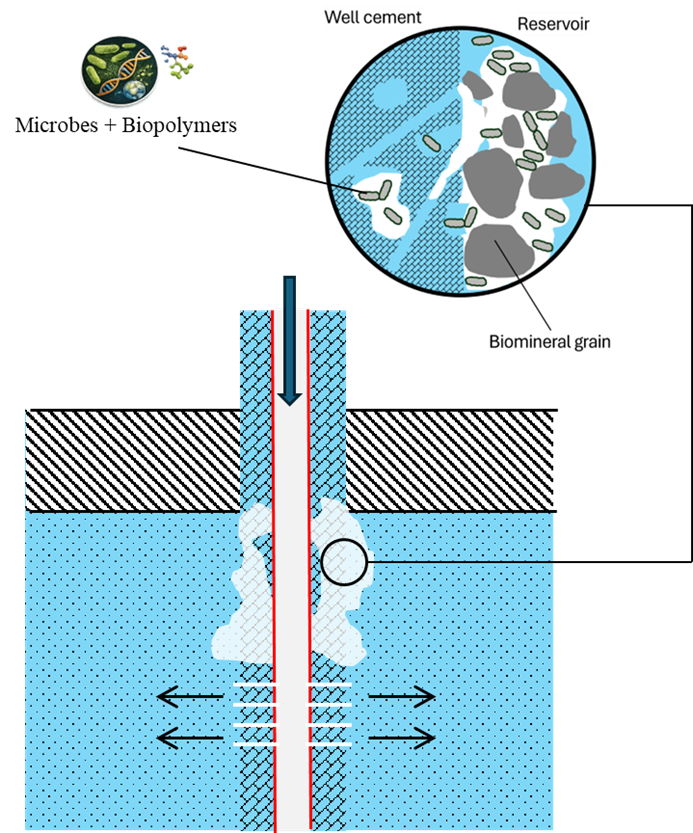
This illustration shows a concept of using Microbially Induced Carbonate precipitation for the remediation of a degraded well as an example of application of engineered MICP in geotechnical contexts. The injected solution composed of biopolymer and microbes leads to controlled biomineralization around the well-cement reservoir interface.
Funding: Deutsche Forschungsgemeinschaft (DFG) – Project number 568788283 (ANR-DFG French-German Collaboration for Joint Projects in Natural, Life and Engineering Sciences)
Researcher: Emna Mejri, Prashant Kashyap; PI: Anozie Ebigbo
Project partners:
- Dorian Davarzani, Fabienne Battaglia-Brunet (French Geological Survey, BRGM);
- Daniel Chevrier, Emilie Gachon (Biosciences and Biotechnoligies Intitute of Aix-Marseille, BIAM);
- Béatrice Colin, Isabelle Lanneluc, Sophie Sablé (Laboratoire Littoral Environnement et Sociétés, LIENSs La Rochelle University) ;
- Malo Duportal, Marc Jeannin, Philippe Refait, Philippe Turcry (Laboratoire des Sciences de l´Ingénieur pour l´Environnement, LaSIE, La Rochelle University)
Project-related presentations:
External link: https://gepris.dfg.de/gepris/projekt/568788283?language=en

Letzte Änderung: 7. April 2026