Wireless Industrial IoT (WIIoT) & Coexistence Management
In highly flexible, modular, adaptable factories, hard-wired cable connections reach their limits. The Wireless Industrial IoT research group at the EMT Chair is developing highly robust, deterministic wireless solutions for demanding manufacturing environments with severe metallic multipath propagation.
Our Core Competencies
- Real-time-capable wireless systems: Latency of less than 3 ms and guaranteed cycle times for time-critical control loops.
- Channel Measurement & Simulation: Spatially Resolved 3D Wavefield Estimation and Multichannel Radio Channel Emulators.
- Interference-Free Parallel Operation: Dynamic frequency and power management when Wi-Fi (Wi-Fi 6/7), Bluetooth, and private cellular networks are all in use simultaneously.
Spectrum Monitoring & Coexistence Management
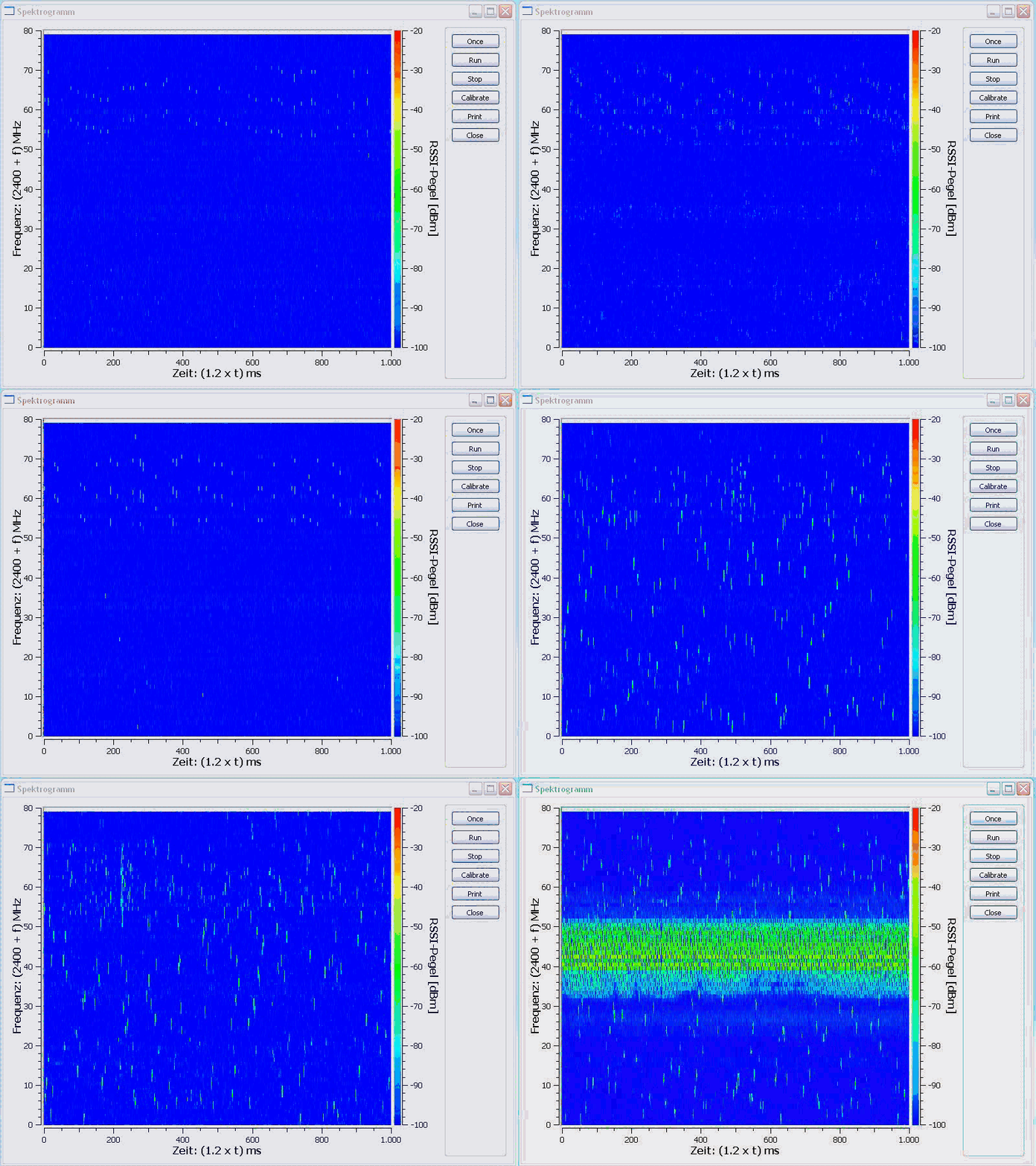
Comprehensive 2.45 GHz spectrum monitoring
The department has developed a real-time, cost-effective spectrum analyzer that monitors the entire 2.45-GHz ISM band. The system detects and classifies interfering wireless systems (e.g., Wi-Fi 802.11ax, Bluetooth LE, ZigBee, or Wireless HART) within milliseconds and enables adaptive avoidance strategies.
Sorting System (“Ball Sorter”)
High-Speed Sorting System: 3 ms Latency Under Interference
The wireless demonstrator developed at the department pneumatically sorts colored test balls at high throughput speeds. Less than 3 ms elapses between optical color detection at the sensor node and the pneumatic ejection nozzle. The demonstrator proves the absolute immunity to interference of the developed wireless protocol, even with three high-load Wi-Fi systems transmitting simultaneously.
Broadband Radio Channel Measurement Technology (MCCW Method)
7-Channel Broadband Radio Channel Measurement System
To physically measure industrial multipath propagation, the department uses a multi-carrier continuous-wave (MCCW) method with 81 parallel carriers and a bandwidth of 110 MHz. The system enables the time-synchronized acquisition of up to 7 radio channels in real time with cycle times of just 100 µs—coupled with synchronous video surveillance for scene analysis.
Past Projects & Partners (Summary)
- Industry partners: Festo AG & Co. KG, Airbus Operations GmbH, EnOcean GmbH, Radlabor Freiburg.
- Funded preliminary work: BMBF projects ESIMA, MARIO, MIKOA, ASYMOF; BMWi project ENAS.
Letzte Änderung: 28. August 2026