Master, Bachelor and Student Theses
Title:
Design of a Laboratory Experiment on Dynamic Self-Heating of Transistors
(Master’s Thesis)
Type:
Circuit and Device Simulation; Experimental Work
Description:
The Chair of Electronics intends to develop a new laboratory experiment for the “Integrated Circuits” laboratory course focusing on the dynamic self-heating of transistors. A simple amplifier circuit will serve as the demonstration setup. Students will be required to design and build the circuit. They will then investigate the stability of its operating point both experimentally, by means of measurements, and using the LTspice circuit simulator. The experiment is intended to demonstrate to students that significant differences can arise between measured and simulated results because LTspice does not inherently account for an important effect: the dynamic self-heating of electronic components.
To provide students with a visual illustration of the dynamic self-heating process inside a transistor, an appropriate model is to be developed for the ATLAS device simulator. This model should make it possible, for example, to generate time-dependent 2D temperature profiles.
(Further information on device simulation can be found, for example, at the following Link).
The ATLAS transistor model should also be capable of quantitatively reproducing the measured temperature-induced drift of the operating point by means of a so-called mixed-mode simulation.
Based on the findings, suitable measures are to be derived to enable self-heating to be modelled at the circuit-simulation level as well.
Requirements / Prerequisites:
- Good knowledge of semiconductor physics, as taught, for example, in the “Integrated Circuits” course.
- Good knowledge of electronics and experience in circuit simulation using LTspice, as taught, for example, in the “Electronics” course.
- Willingness to familiarise oneself with the complex field of semiconductor device simulation.
- Initiative, strong motivation, and the ability to work independently.
Contact:
- Prof. Göbel
- Dr. Siemund
Title:
Preliminary Study for the Development of an Educational Web-Based Semiconductor Device Simulator (Master’s Thesis)
Type:
Programming Task (possibly using AI tools)
Description:
To support the “Integrated Circuits” course, the Chair of Electronics is considering the development of a web-based device simulator for two-dimensional semiconductor structures. (Further information on device simulation can be found, for example, at the following Link).
Given the substantial overall effort anticipated, the software is to be developed in several stages (possibly using AI tools):
In the first stage, the Poisson equation is to be solved for a rectangular simulation domain using a numerical method, such as the finite difference method. Boundary conditions for the electrostatic potential (so-called Dirichlet boundary conditions) and material parameters (in this case, the permittivity only) should be configurable interactively and as a function of position. The calculation results should be presented graphically in an appropriate manner.
In the second stage, the continuity equations for electrons and holes are to be implemented in order to model carrier drift and diffusion.
In the third stage, users should be able to define different semiconductor regions with different doping profiles, as well as different electrodes.
Further optional stages may include the addition of different recombination models, mobility models, or boundary conditions. They may also provide graphical visualisation of all relevant quantities (electric field strength, potential, current density, carrier concentration, recombination rate, etc.).
Requirements / Prerequisites:
- Good knowledge of semiconductor physics, as taught, for example, in the “Integrated Circuits” course.
- Good knowledge of electrostatics, as taught, for example, in the “Theoretical Electrical Engineering” course.
- Willingness to familiarise oneself with the highly complex fields of semiconductor device simulation and numerical solution methods.
- Programming experience.
- Initiative, strong motivation, and the ability to work independently.
Contact:
- Prof. Göbel
- Dr. Siemund
Title:
Development of an Educational Web-Based Simulator for Digital Circuits
(Bachelor’s Thesis)
Type:
Programming Task (possibly using AI tools)
Description:
To support the ISA lecture “From the Abacus to the Supercomputer”, the development of a web-based simulator for simple digital circuits is being considered.
The simulator is intended to help ISA students with limited experience in digital circuits develop an intuitive understanding of the operation of basic logic gates (AND, OR, XOR) on their own smartphones or tablets. For example, students should be able to change the logic levels at the gate inputs and observe how this affects the logic level at the output.
Furthermore, the simulator should enable students to check the correct operation of simple logic circuits that they are required to design as part of the course.
Requirements / Prerequisites:
- Basic knowledge of digital logic.
- Programming experience.
- Initiative, strong motivation, and the ability to work independently.
Contact:
- Prof. Göbel
- Dr. Siemund
Automatic Parameter Extraction Tool for MOSFET Modelling (Bachelor/Master Thesis)
Type: Programming
Description
(a)
(b)
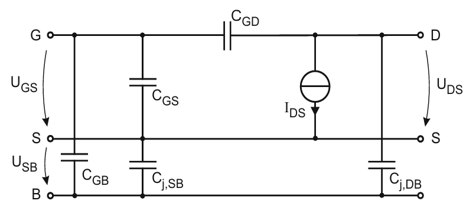
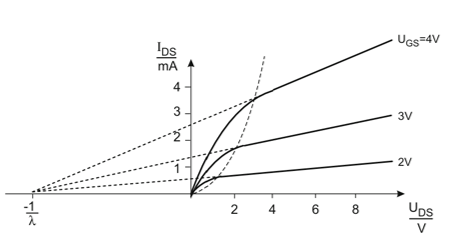
Fig. MOSFET equivalent in circuit with intrinsic capacitances and current source (b) Typical MOSFET output characteristics with varying gate-source voltage.
A MOSFET is a fundamental element in complex circuits and devices for switching applications. Designers use the standard MOSFET spice models to design complex circuits for fast prototyping. However, in reality these models do not describe the MOSFET behavior accurately in all cases for which advanced physics-based models are required. The models consist of various parameters which are often tedious to obtain. An easier and faster way would be to extract from datasheet curves or published results. The scope of this project is to build an automatic parameter extraction tool that could be used in complex SPICE models.
Scope of this thesis
- Develop parameter extraction tool from published static and dynamic measurements.
- Compare the results from datasheets to the SPICE models with extracted parameters.
- Documentation of the work.
Requirements
- Fundamentals of electronics, especially transistors and semiconductors.
- Programming skills, MATLAB/Python desired.
- Highly motivated and self-independent to work.
- Basic understanding of SPICE simulator tools such as LTSpice is highly appreciated.
Contact Person:
Prof. Herr. H. Göbel
Dr. H. Siemund
M.Sc. Reema Shrestha
Influence of the device parameters on the electrical output characteristics of Power MOSFET (Bachelor-/Masterarbeit)
Type: Simulation
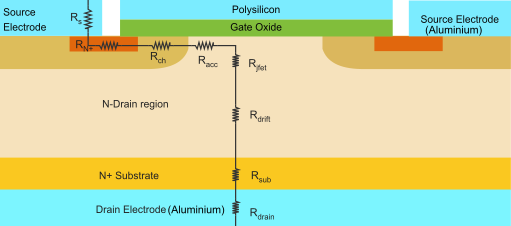
Fig. 1. Cross-sectional structure of a planar Power MOSFET highlighting the contribution of different sections of the body in the on-state resistance.
A Power MOSFET is a fundamental element in complex circuits and devices for switching applications delivering high power. However, there are challenges encountered such as heating of the die at high power due to power dissipated and thermal resistances which can eventually break the transistor. To understand these effects, physics-based device modeling is quite crucial. However, such modeling can get quite complex and time consuming depending on different parameters. This project focuses on investigating the influence of some of the crucial parameters on static and dynamic characteristics.
Scope of the project
- Implementing the MOSFET structure of a commercial device along with parameter extraction in TCAD (Technology Computer Aided Design) TCAD Tutorial.
- Studying the impact of different parameters and physical models along with mesh convergence.
- Documentation of the work.
Requirements
- Fundamentals of semiconductors, especially transistors.
- Highly motivated and self-independent to work.
- Basic understanding of device simulators, such as TCAD, is highly appreciated.
Contact person:
Prof. Herr. H. Göbel
Dr. H. Siemund
M.Sc. Reema Shrestha
Letzte Änderung: 11. November 2026