Our research is dedicated to the intelligent sensing, processing, and analysis of (bio-)signals. At its core, we pursue domain-informed signal processing that bridges classical methods with modern machine learning frameworks — including deep learning and generative models. A central goal is to develop models that are not only powerful, but also interpretable, tunable, and efficient in practice.
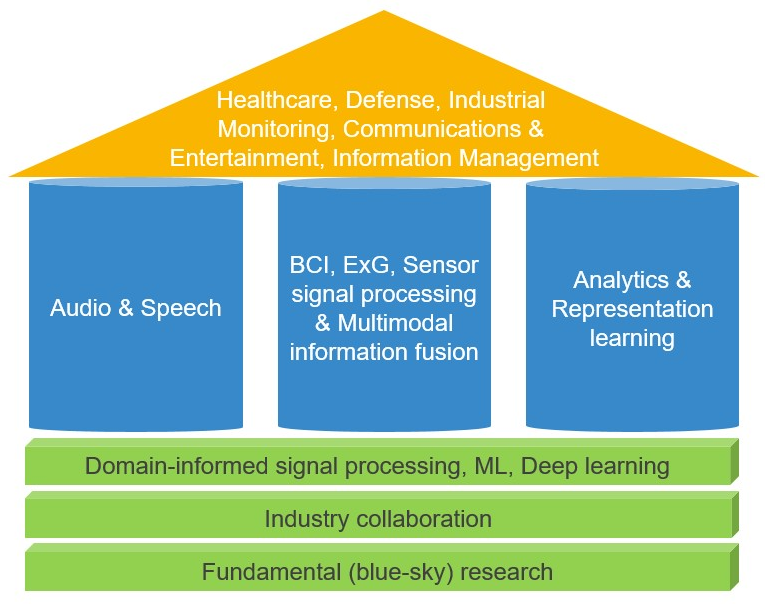
Our work is structured around three complementary research pillars, as illustrated in the figure: audio & speech, BCI, ExG, and sensor signal processing with multimodal information fusion, and analytics & representation learning. Together, they rest on solid foundations — deep signal processing expertise, concrete research problems driven by industry applications, and fundamental, blue-sky studies with high risk and high potential impact.
Key thematic areas include (bio-)signal analytics (e.g., EEG/ExG), brain–computer interfaces (BCI), signal detection and enhancement, sensor and information fusion, as well as time-series analysis and anomaly detection.
Letzte Änderung: 9. October 2026