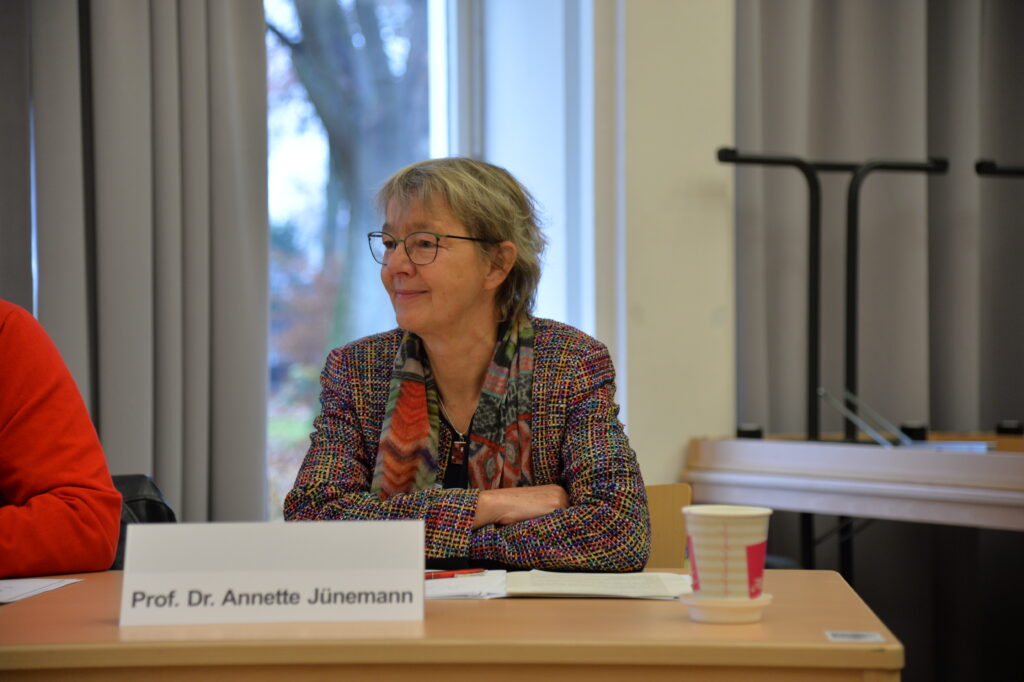
Die Forschungsschwerpunkte von Prof. Dr. Annette Jünemann und ihrem Team liegen im Bereich der Internationalen Beziehungen, insbesondere in den EU-Außenbeziehungen. Ein regionaler Schwerpunkt liegt im Mittelmeerraum (EuroMed), dem Nahen Osten und Nordafrika. In diesem Kontext interessieren uns Transformations- und Demokratisierungsprozesse, auch aus Perspektive der Geschlechterforschung. Aktuell bearbeiten wir den Themenkomplex Flucht und Migration. Genauere Informationen finden sie unter den Rubriken Forschung, Team sowie Studium & Lehre .
Sprechstunde:
Im FT2024 findet die Sprechstunde individuell nach Absprache statt. Bitte kontaktieren Sie hierfür Frau Prof. Jünemann und Frau Göttsche direkt per e-Mail.
Aktuelles:
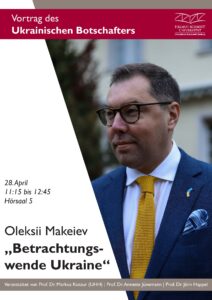
Hier finden Sie den Bericht über den Besuch des ukrainischen Botschafters Oleksii Makeiev am 28.4.2023 an der HSU
Neue Publikationen:
Gedikli, Ardahan / Jünemann, Annette (2024): Deutschland und die europäische Mittelmeerpolitik. In: Böttger, Katrin / Jopp, Mathias (Hrsg.): Handbuch zur Deutschen Europapolitik. Baden-Baden, zweite Auflage. Nomos (im erscheinen)
Jenseits der Krisen: Potenziale der europäischen Integration im 21. Jahrhundert
Das Buch richtet den Fokus auf die Potenziale der Europäischen Union für das 21. Jahrhundert. Ausgehend von den inneren und äußeren Krisen, denen sich die EU gegenübersieht, bietet der Band einen analytischen und umfassenden Überblick zu aktuellem Zustand und zu Perspektiven der europäischen Integration. Dem Band liegt der Kerngedanke zugrunde, dass es trotz oder gar wegen der aktuellen Krisen zahlreiche Potenzialthemen gibt, die neues Vertrauen in die EU schaffen können. Diese oft unerkannten oder missverstandenen Kraftreserven der Union werden von einschlägigen Expert*innen identifiziert, analysiert und diskutiert. Link to Springer here
Jünemann, Annette (2023)„Die Zivilgesellschaft der Europäischen Union im Politikfeld Asyl und
Migration: Hoffnungsträger mit begrenztem Handlungsspielraum. In: Gieg, Philipp / Lowinger, Timo / Pietzko, Manuel / Rüger, Carolin / Scheuermann, Manuela / Zürn, Anja (Hrsg.): Jenseits der Krisen: Potenziale der europäischen Integration im 21. Jahrhundert, Wiesbaden: SpringerVS. S. 253-284, PDF
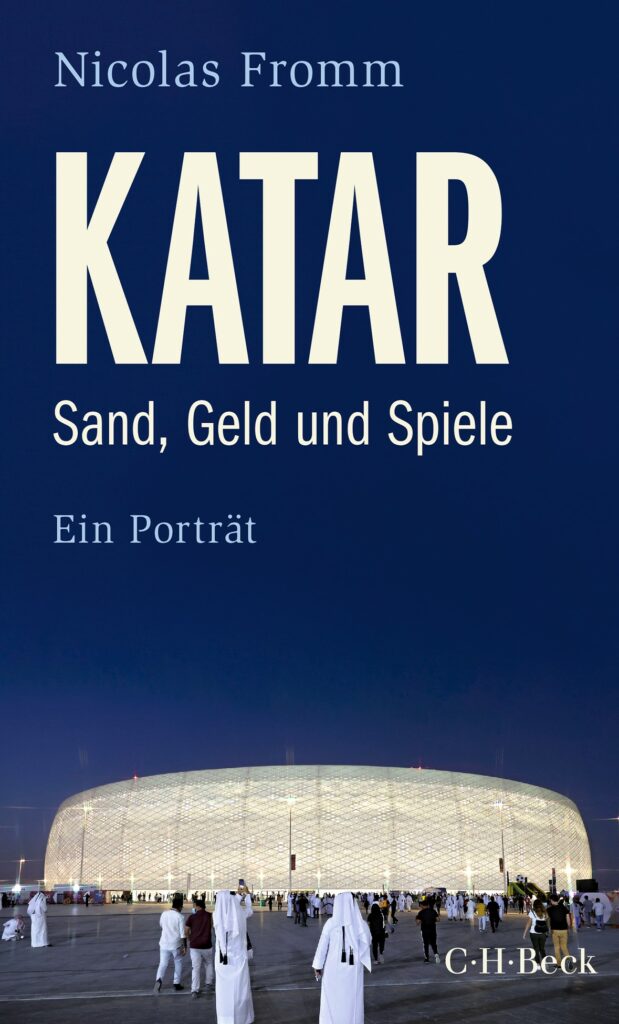
Das Sachbuch „Katar: Sand, Geld & Spiele“ (Nicolas Fromm) ist im Herbstprogramm 2022 des C.H. Beck-Verlages erschienen
Katar, die sandige Halbinsel im Persischen Golf, ist international so aktiv und einflussreich wie kaum ein anderer Kleinstaat. Das absolutistisch regierte Emirat wurde – auch dank der Arbeitskraft unzähliger Gastarbeiter aus aller Welt – zum wichtigen Öl- und Gasexporteur und zum reichsten Land der Welt. Das Land ist zudem die Heimat des Fernsehsenders Al-Jazeera, der trotz umstrittener Positionen weiterhin für informative Berichte aus der arabischen Welt bekannt ist. Auch der Sitz des Hauptquartiers der US-Truppen in der Region befindet sich auf der außergewöhnlich kleinen Halbinsel. Die Meinungen über Katar schwanken zwischen Staunen und Verurteilung. Der Mittelost-Experte Nicolas Fromm porträtiert unvoreingenommen, anschaulich und aktuell ein Land im Umbruch, das sich bisher erfolgreich allen Schubladen entzogen hat.
Weitere Informationen: https://www.chbeck.de/fromm-katar/product/33743712
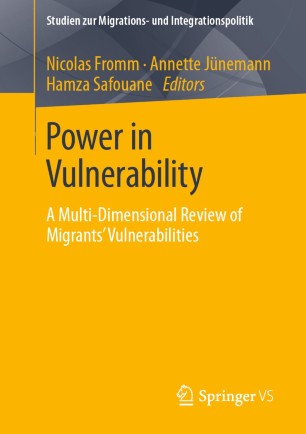
The Anthology “Power in Vulnerability. A Multi-Dimensional Review of Migrants’ Vulnerabilities” has been published.
With this volume, the editors propose a multi-dimensional and critical review of migrants’ vulnerabilities. They argue that a deeper understanding of vulnerability is paramount to discuss empowerment and resilience. Regardless of their motivations, migrants can face vulnerabilities at any of the stages of their journey. These vulnerabilities may change over time for better or worse, corresponding with a person’s legal status, migratory path and the practices of migration regulation. This book addresses vulnerability from an interdisciplinary and intersectional perspective. It brings together latest academic research and practitioners’ insights to help reception societies adapt and improve their dealing with migrants’ vulnerabilities.
The volume includes articles by Prof. Dr. Jünemann, Dr. Fromm, Dr. Safouane, Sandra Göttsche and Yaiza Rojas Matas, from the Department of International Relations at the HSU.
More information in the following link: https://www.springer.com/de/book/9783658340513#aboutAuthors
Book Launch: „Winds of Change? Negotiating Gender Relations in the Middle East and North Africa“ (Annette Jünemann)
Webinar to launch the Routledge Handbook of EU-Middle East Relations, edited by Dimitris Bouris, Daniela Huber and Michelle Pace. Section 4, MENA–EU Relations in the Contemporary World, Amsterdam Center for European Studies, 20.04.2022
More information: https://www.routledge.com/Routledge-Handbook-of-EUMiddle-East-Relations/Bouris-Huber-Pace/p/book/9780367330767
Aus der Lehre:
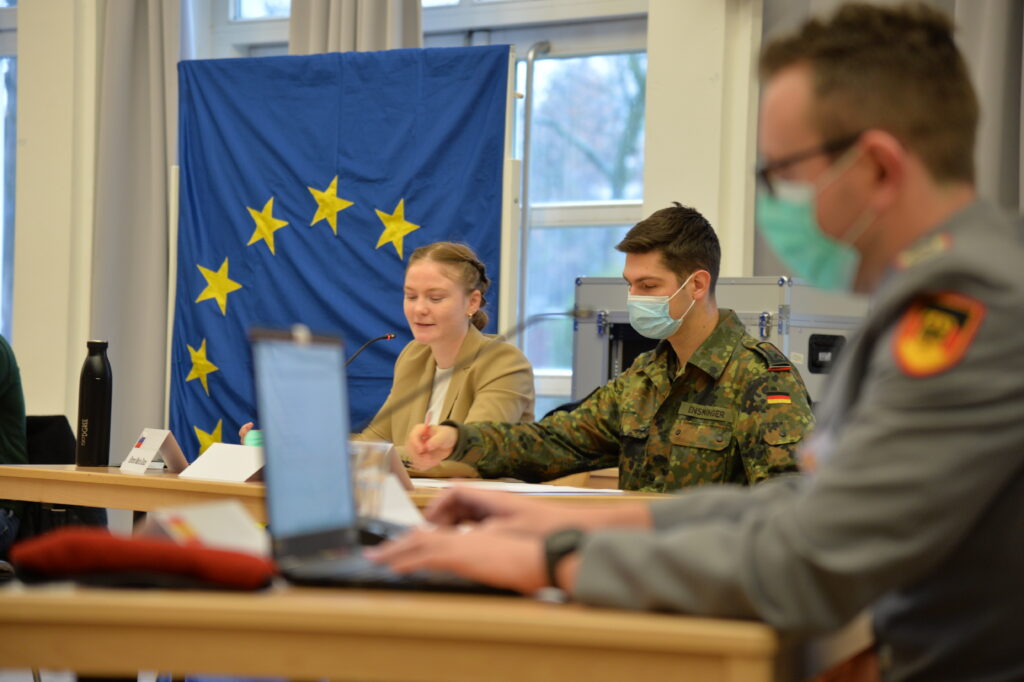
- Simulation game “Via Pontica – Bridge over Troubled Waters”: EU Crisis Management Exercise:
Is there a solution to the distribution dilemma of refugees in the EU? That question was given out to a group of undergrads, consisting out of civilian and military students, at Helmut-Schmidt University. In order to simulate a realistic EU Council meeting (25th-26th of November 2021), students got together in pairs, to play a given country at that exact meeting. Their scenario was a refugee crisis along the shores of the Romanian Black-Sea coast. In doing so, students were able to get an impression of what it takes to come up with a solution to a given problem, on which every country can agree upon.
Navigating through what seemed a “jungle of different interests”, the EU Council president of Slovenia put in a lot of effort, to keep every member state in the discussion and to give out a fair share of talking time to each state. In the end, the EU Council found a way to deploy European police forces and humanitarian aid. Nevertheless, a general solution for the current migration situation and its distribution component could not be found. Afterwards, students acknowledged how hard it can be, to satisfy each member state. Still, students appreciated the simulation game very much, their only request for another simulation game: more time. That being said, it was a pleasant and valuable experience for students, as well as for the teaching staff.